The short answer
Almost every small business should start with a website. Build an app only when your customers would open it often — every week or more — or when your staff, riders or partners need a tool to do their job. If neither is true, a fast website with WhatsApp and online payments will serve you better for less.
This guide explains why, walks through common Indian business types, and covers the middle path: a web app people can install on their phone without an app store.
Why a website comes first
When someone hears about your bakery, clinic or coaching centre, they search for it on Google. A website is what they find — along with your Google Business Profile. It answers the basic questions (what you do, where you are, when you are open, what it costs) and gives them a way to act: call, WhatsApp, book or buy.
An app cannot do that job. Nobody downloads an app from a business they have not used yet. Apps are for people who already know you.
- It is found. Websites rank on Google; apps mostly do not.
- It has no install step. One tap from a search result or a WhatsApp link.
- It is cheaper. A good small business site costs a fraction of an app. See website costs in India.
- It works everywhere. Any phone, any browser, no storage space needed.
When an app earns its place
An app becomes worth it when at least one of these is true.
- High frequency. Customers order or book weekly or daily — milk, groceries, meals, classes, gym sessions.
- Notifications matter. Order status, delivery tracking, appointment reminders or live class alerts.
- Your team needs a tool. Riders, delivery staff, field agents, teachers or technicians who do their work through it.
- Phone features. Camera for scanning or AR try-on, location for tracking, offline use in the field.
- Loyalty and subscriptions. Wallets, plans, pause-and-skip, points and repeat orders.
A dairy subscription is a classic case: customers adjust tomorrow's order every evening, and the delivery person needs a route sheet at 5 am. Our Milvara concept has exactly those two sides. See subscription delivery apps.
What fits your type of business
| Business | Start with | Add an app when… |
|---|---|---|
| Bakery or cake shop | Website with order form and WhatsApp | Repeat pre-orders and pickups become a daily volume |
| Clinic or physiotherapy | Website with online booking | Patients need reminders, records and follow-up plans |
| Restaurant | Website with menu, plus QR table ordering (web) | You run your own delivery or a loyalty programme |
| Kirana or local shop | Google Business Profile, WhatsApp catalogue, simple site | You deliver daily to a regular set of homes |
| Coaching institute | Website with courses and admissions enquiry | You run live classes, tests and doubt solving |
| School | Website for admissions | Parents need attendance, homework, fees and notices |
| D2C brand | Online store | You have repeat buyers, drops or a companion feature |
| Salon or home services | Website with booking | You dispatch staff to homes and track their visits |
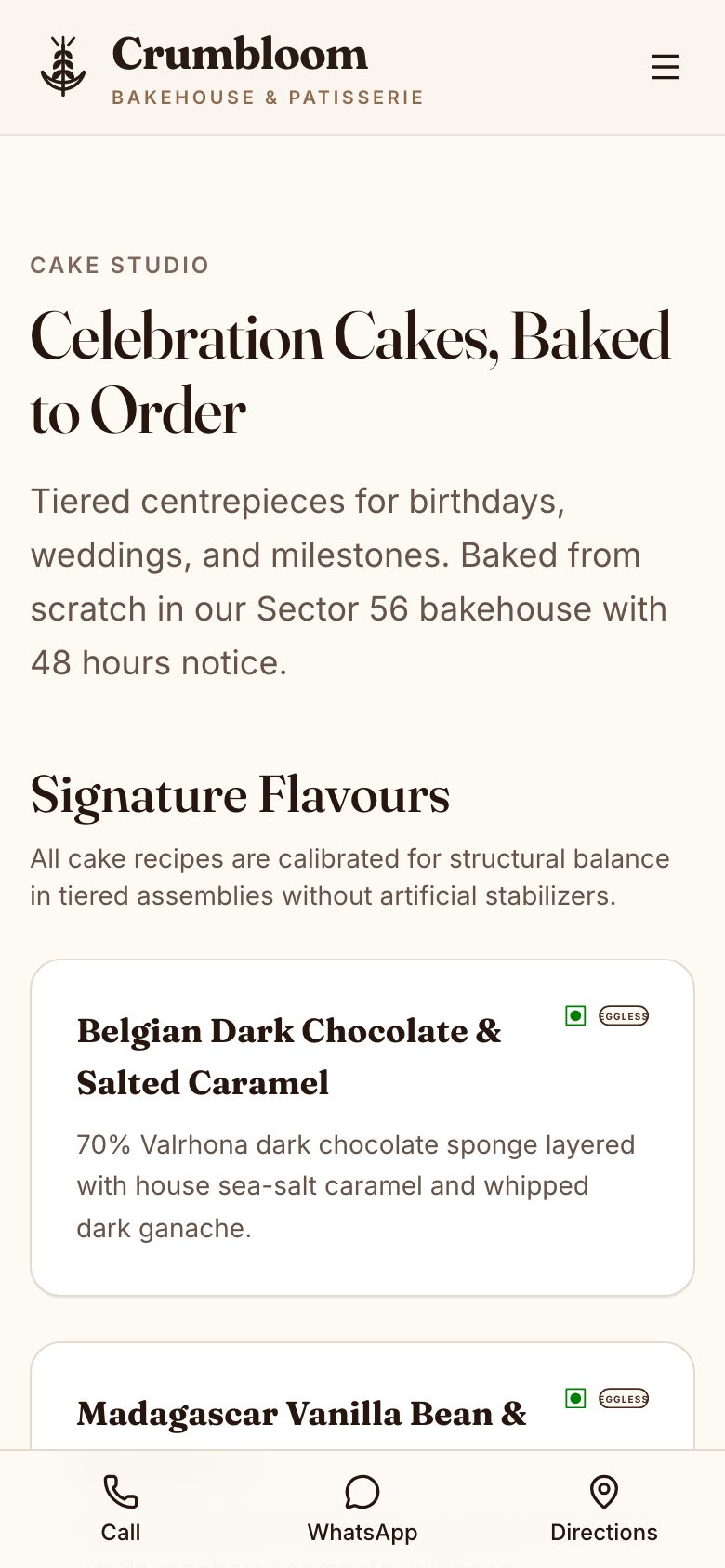
For examples of each, look at Crumbloom (bakery website), Moviva (clinic site with booking), Tabletap (restaurant QR ordering) and Chalkline (school website and parent app).
The middle path: an installable web app
A progressive web app (PWA) is a website that can be added to a phone's home screen, open full-screen like an app, work partly offline and, on Android, send notifications. There is no app store listing and no download of tens of megabytes.
PWAs are a good fit for staff tools (a counter tablet, a rider's run sheet), for customers who use you a few times a month, and for testing whether people would use an app before you build a native one. Our Peakride scooter-rental concept uses an installable web app for its counter staff.
PWAs have limits. Notifications on iPhones are more restricted than on Android, and features like background location or deep camera use are better in a native or cross-platform app. Read native, cross-platform or PWA? for the trade-offs.
Where WhatsApp fits
For many Indian small businesses, WhatsApp is already the app their customers use to talk to them. That is not a reason to skip a website — it is a reason to connect the two. A website can send enquiries straight to WhatsApp; order confirmations and reminders can go out as WhatsApp messages; your team can reply from a shared inbox instead of one phone.
Read WhatsApp and your app for how businesses wire this up, and see our Replyvo concept for a shared business inbox.
Comparing the cost
| Option | Ballpark build cost (small studio) | Yearly running cost |
|---|---|---|
| Template business website | ₹50,000–1.5 lakh | A few thousand rupees |
| Custom website with booking or ordering | ₹2–8 lakh | ₹10,000–50,000+ |
| Installable web app (PWA) | ₹3–10 lakh | ₹20,000–1 lakh |
| Customer app (Android and iOS) | ₹5–15 lakh | 15–25% of build cost |
| Customer app + staff app + dashboard | ₹10–30 lakh | 15–25% of build cost |
Mistakes small businesses make with a first app
- Building an app before customers are asking for one. If your regulars are happy calling or messaging you, an app adds a step rather than removing one.
- Copying a big platform's feature list. You do not need a wallet, referral programme and loyalty tiers on day one. You need ordering or booking to work every single time.
- Forgetting the staff side. If orders arrive in the app but your kitchen or counter still works from a notebook, the app creates confusion rather than saving time.
- No plan to get downloads. An app needs a reason to install — a first-order offer, a QR code at the counter, a message to existing customers. Without one, it sits unused.
- Letting the website go stale. New customers still find you on Google. Keep the site current even after the app launches.
- Ignoring upkeep. Apps need updates every year to keep working on new phones. Budget for it; see what an app costs after launch.
A quick decision checklist
- Do you have a website that loads fast on a phone and ranks for your business name? If not, start there.
- Do customers use you more than twice a month? If not, a website is probably enough.
- Do staff or partners need a tool to do their job? If yes, that tool may matter more than a customer app.
- Do you need phone features — tracking, camera, offline? If yes, consider an app.
- Could a web app test the idea first? If yes, do that before a full app.
If you want a second opinion, send us a short brief. We will tell you honestly if a website is all you need. You can also browse what we build across India.
Questions people ask
Does a small business in India need a mobile app?
Most do not, at least not at first. A fast website, a Google Business Profile and WhatsApp cover discovery, enquiries and orders for most small businesses. An app becomes worthwhile when customers use you weekly or more, when you need notifications or tracking, or when your staff or delivery team need their own tool.
Is a website or app better for an online store?
Start with a website. It is what people find on Google and can buy from without installing anything. Add an app later if you have many repeat buyers, run limited drops, or want features like saved sizes and push notifications. Many successful Indian D2C brands sell mostly through their website for years.
What is a PWA and is it cheaper than an app?
A PWA, or progressive web app, is a website that can be installed on a phone's home screen and behave like an app, without an app store. It is usually cheaper than building separate Android and iOS apps, and works well for staff tools and occasional customers. Native features like background location are more limited.
Can I convert my website into an app later?
Yes. If your website is built on a modern stack with a proper backend, an app can reuse the same data, accounts and payment setup, so you are not starting from scratch. Plan for this early: keep your product data, customers and orders in a system an app can connect to, not inside a page builder.


