The short answer
A packers and movers business packs a family's or an office's belongings, loads them, moves them and unpacks them at the other end. It is a trust business in a sector known for surprise charges and damaged goods, so honest quotes, careful packing and clear insurance are how you stand out.
Most new movers start local, within one city, using hired or attached vehicles and a small trained crew. Intercity moves, warehousing and vehicle transport come later. Your two biggest risks are damage claims and hidden costs, so put prices, packing materials and insurance in writing before any move.
Is a packers and movers business right for you?
People in India move for jobs, studies, marriage and new homes, and offices relocate as they grow. Demand peaks at the end of months, at the start of academic years and around transfers. Many customers have had a bad move before and are looking for a company they can trust.
You will do well if you are organised, good at estimating volume, firm about safety and comfortable managing crews and drivers. It is physical, time-bound work where planning prevents most problems.
- The hard parts: damage claims, last-minute vehicle shortages, lifts that are not booked, parking rules, and price-shopping customers.
- What helps: a survey before every quote, good packing materials, a trained crew and transparent insurance.
- What to avoid: quoting low and adding charges on moving day. It is the fastest way to bad reviews.
Business models to choose from
| Model | How it works | Suits |
|---|---|---|
| Local household shifting | Moves within a city, priced by volume, floors and distance. | New businesses with a small crew |
| Intercity relocation | Long-distance moves by dedicated or shared truck, with transit insurance. | Businesses with partner networks in other cities |
| Office and commercial moves | Weekend moves of desks, IT equipment and files, with labelling and setup. | Founders who can sell to businesses |
| Mini-truck and helper on demand | Customers book a vehicle and helpers by the hour for small moves. | Asset-light founders using driver partners |
| Storage and vehicle transport | Warehousing between moves, and shipping cars and bikes. | Established movers adding revenue lines |
Whatever you choose, be clear about what is included. Packing materials, dismantling and reassembling furniture, wall-mounted TVs, appliances, plants and vehicles are where most disputes start. A written list of what is included and what costs extra protects both you and the customer.
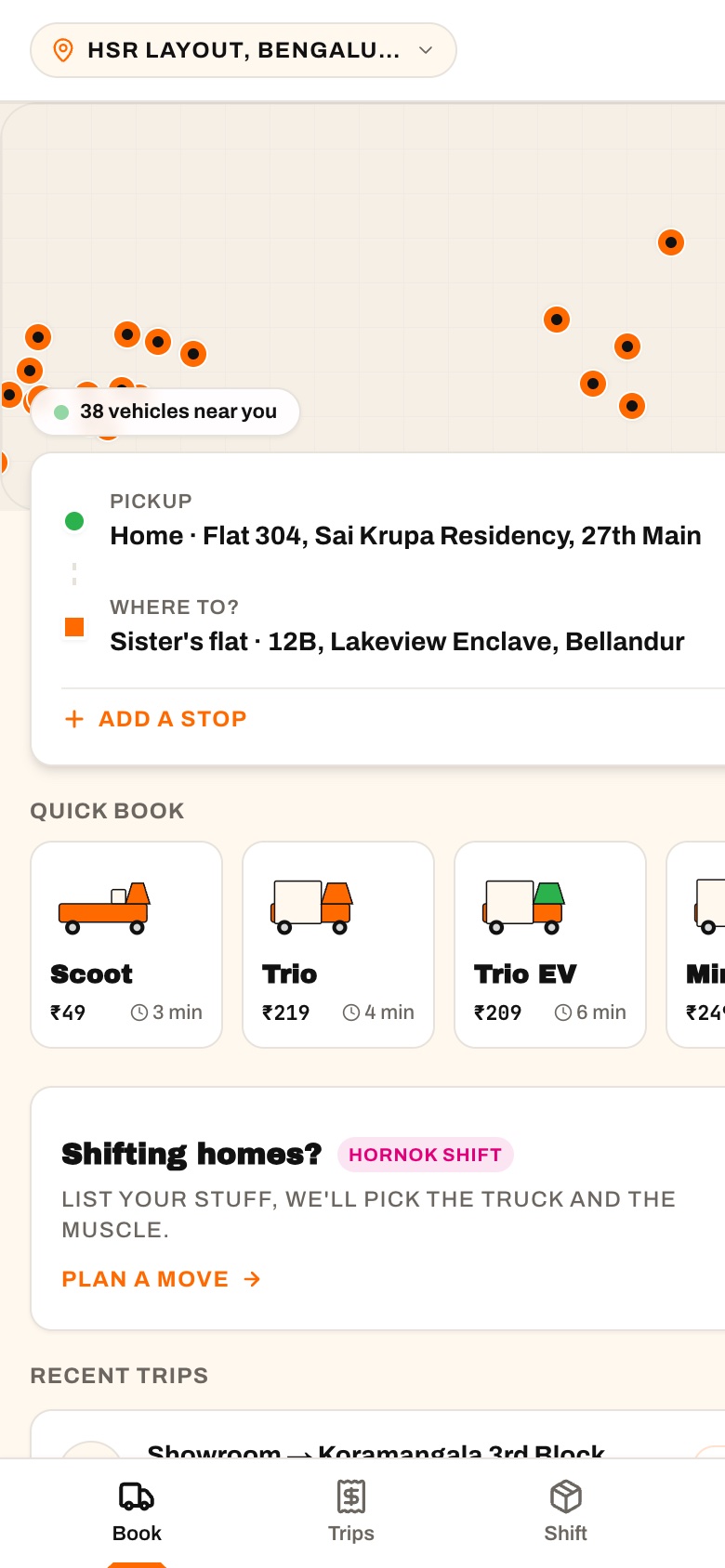
The on-demand mini-truck model sits close to a transport business. Our HornOK concept build explores it: vehicle size selection, helper add-ons, multi-stop routes and a driver app.
Licences and registrations
| Registration | Why you need it | Where you get it |
|---|---|---|
| Business structure | Sets liability and tax treatment. | A CA; LLPs and companies register with the Ministry of Corporate Affairs |
| GST registration | Required once turnover crosses the threshold; corporate clients expect GST invoices. | The GST portal |
| Shop & Establishment / trade licence | Covers your office or warehouse under state and municipal rules. | Municipal body or state labour department |
| Commercial vehicle registration, permits and fitness | Vehicles carrying goods for hire need commercial registration, goods-carriage permits and valid fitness certificates. | Regional Transport Office |
| Common carrier registration | Businesses carrying goods for others may need to register under carriage-by-road rules. | State transport authority |
| Commercial vehicle and transit insurance | Covers your vehicles, and offers customers cover for goods in transit. | General insurers |
| E-way bill and transport documents | Goods in transit may need e-way bills or other documents depending on what is moved. | The e-way bill portal; confirm with your CA |
Transport and tax rules vary by state, vehicle and type of goods, and they change. Confirm with a CA and your RTO before you start operating. This is general information, not legal advice.
What it costs to start
| Item | Small start | Larger setup |
|---|---|---|
| Registrations, CA and agreements | ₹15,000–40,000 | ₹50,000–1.5 lakh |
| Vehicles | Hired or attached vehicles, paid per trip | ₹20–60 lakh to own several trucks |
| Packing materials | ₹30,000–75,000 | ₹3–6 lakh |
| Tools and equipment (trolleys, straps, ladders) | ₹20,000–50,000 | ₹2–5 lakh |
| Warehouse or storage space | Not needed at first | ₹50,000–2 lakh a month plus deposit |
| Crew uniforms, safety gear and training | ₹20,000–50,000 | ₹2–4 lakh |
| Marketing and working capital | ₹1–3 lakh | ₹10–25 lakh |
These are rough planning estimates, not quotes. Owning vehicles changes your costs sharply, so many movers hire or attach vehicles until volume is steady.
Step by step: from idea to first customer
- Start with local moves in one city and decide whether you will own or hire vehicles.
- Register the business and sort vehicle permits, fitness and insurance with your RTO and insurer.
- Hire and train a crew in packing, lifting safely, and wrapping furniture and electronics.
- Buy good packing materials: boxes, bubble wrap, stretch film, corner guards and blankets.
- Write a pricing method based on volume, floors, lift access, distance and packing.
- Survey every home — in person or by video call — before giving a written quote.
- Offer transit insurance and explain clearly what it covers.
- Prepare an inventory list that the customer signs at loading and unloading.
- Set up a Google Business Profile, a WhatsApp Business number and a simple website.
- Partner with builders, brokers, HR teams and housing societies for referrals.
- Follow up after every move, settle any claim quickly and ask for a review.
Running it day to day
The day before a move is as important as the move itself: confirm the vehicle, crew, materials, lift booking and parking at both ends. On the day, a supervisor runs the checklist and keeps the customer informed.
- Crew and fair pay. Pay on time, provide gloves, back belts and lifting training, and keep moves within safe working hours.
- Quality checks. Check fragile items before sealing boxes and label every box by room.
- Tracking. Share the vehicle's live location on intercity moves; customers worry when they cannot see their belongings.
- Claims. Have a written claims process and settle fairly. Customers remember how you handled a broken item more than the item itself.
- Cash flow. Take an advance on booking and the balance on delivery, by UPI where possible.
Month-end and the start of the academic year are your busiest days, and vehicles get scarce. Lock in vehicle partners and extra crew for those dates early, and price peak days honestly rather than overbooking. For intercity moves, share an expected delivery window in writing and update the customer when the truck crosses each city.
Getting your first customers
Customers search “packers and movers near me” and read reviews carefully because they fear fraud. A verified Google Business Profile with real photos, a physical address you actually operate from and honest reviews is your strongest asset. Our local SEO guide explains how.
- Transparent quotes. Publish how you price, and send itemised written quotes. It sets you apart immediately.
- Referral partners. Brokers, builders, HR teams and relocation desks see moves before they happen.
- Societies. Notice boards and society WhatsApp groups reach people planning moves.
- Repeat business. Corporate clients move staff often; a reliable record can win annual contracts.
The tech you need
Start with a quote template, a video-survey process, a signed inventory list and UPI. As you grow, you need online booking, vehicle and crew scheduling, live tracking for customers and a record of every claim.
A logistics app typically has a customer app for booking and tracking, a driver app with routes and loading checks, and an ops dashboard. Our HornOK concept build shows vehicle selection, helper add-ons, multi-stop routing and a fleet ops view.
Read our logistics app guide and how app costs work in India before you plan a build, then send us a brief.
See the app a packers and movers business runs on
We designed and built this concept end to end, every side of it, so you can open it and try it before you plan your own. Our logistics app page covers the features, timeline and what moves the cost.
Questions people ask
How much investment is needed to start a packers and movers business?
A local business using hired vehicles can start for roughly ₹2–5 lakh in registrations, packing materials, tools, crew and working capital. Owning a fleet of trucks and a warehouse needs many times that. These are rough planning estimates, not quotes.
What licences do packers and movers need in India?
Typically business registrations such as GST once you cross the threshold, a trade or shop licence for your office, commercial registration, permits and fitness certificates for vehicles, and insurance. Businesses carrying goods for others may also need common carrier registration. Confirm with a CA and your RTO.
How do packers and movers calculate charges?
Usually by the volume of goods, distance, floors and lift access, packing materials, labour and insurance. A survey before quoting avoids surprises. Give customers an itemised written quote and stick to it on moving day. If the customer adds items, agree the extra charge before loading.
Do I need to own trucks to start?
No. Many movers start by hiring or attaching vehicles from local owners and pay per trip. It keeps capital low while you build demand. Owning vehicles makes sense once you have steady volume and can keep them busy most days of the month, with drivers you trust.
How do I handle damage claims fairly?
Prevent most of them with careful packing and a signed inventory at loading and unloading. Offer transit insurance and explain its cover. When something breaks, inspect promptly, follow a written process and settle fairly. A well-handled claim often earns a good review.


