The short answer
Begin with the instruments and vocal styles your teachers can take a beginner through properly, usually keyboard, guitar and Hindustani or Carnatic vocals, and rent two or three small rooms you can soundproof. Register the business and GST, plan for graded exams if parents want certificates, and get music licences sorted before your first public recital.
Roughly, a three-room music school in a tier-2 city can open for ₹6–15 lakh, and a metro school with six to eight treated rooms and a bigger instrument stock often needs ₹30–70 lakh. Below you will find the models, the registrations, the costs, a launch checklist and the software that holds lesson schedules and fees together.
Is a music school right for you?
Music lessons are a long commitment. A child who starts keyboard at seven may still be with the same school at fourteen, and adults who learn guitar or vocals often stay for years because it is their weekly hour off. That long life of each student is what makes a music school work, even though monthly fees are modest.
It suits trained musicians who are patient with beginners, and people who can manage a roster of part-time teachers. Many good teachers also perform in the evenings, so scheduling around their gigs becomes a skill in itself.
- Sound. Drums and amplified guitars travel through walls. Treating rooms costs money, and one neighbour's complaint can end a lease.
- One-to-one economics. Individual lessons pay well per hour but cap how many students a teacher can take. Small group classes for beginners help.
- Plateaus. Students quit when progress slows in the second year. Grades, recitals and band projects keep them going.
- Teacher churn. Part-time teachers move to other schools or online teaching. Keep the curriculum written down so lessons survive a change of teacher.
Business models to choose from
| Model | How it works | Suits |
|---|---|---|
| Individual lessons | One student, one teacher, a weekly slot of thirty to sixty minutes | Adults and serious students; highest fee per hour |
| Group classes | Four to eight beginners learning together on keyboard, guitar or vocals | Children and first-timers; fills rooms efficiently |
| Exam-track school | Lessons follow a recognised board's graded syllabus, with exams twice a year | Parents who want certificates and visible progress |
| Classical guru-led school | A senior teacher runs long-term training in Hindustani or Carnatic music | Teachers with a strong lineage and reputation |
| Online and hybrid | Live video lessons for students elsewhere, alongside in-person classes at your rooms | Schools with a known teacher and students across cities |
Start with group classes for beginners and individual slots for students who are ready to go further. Group batches pay the rent; individual lessons and exam preparation build the reputation that brings in the next intake. If you plan to add dance later, our playbook on starting a dance academy covers floors, batches and recitals.
Licences and registrations
| Registration | Why you need it | Where you get it |
|---|---|---|
| Shop & Establishment registration | Registers your premises and sets rules on staff hours, leave and holidays | State labour department, or the municipal body in some states |
| Trade licence | The city's permission for a commercial activity at your address | Municipal corporation or panchayat |
| GST registration | Required once turnover crosses the limit; register earlier if corporates or schools hire you | GST portal |
| Music licences for performances | Recitals and concerts that use recorded tracks or backing music need permission from the rights holders | The copyright licensing bodies for songs and sound recordings |
| Permissions for public shows | Events in halls, parks or auditoriums may need local police or municipal permission | Local police and the venue management |
| Police verification | Every teacher who works with children, especially in one-to-one lessons | Local police station or the state police citizen services portal |
| Safeguarding policy | Clear rules for lessons with minors: glass panels in doors, attendance records, a complaint route | Written by you with legal help; shared with every teacher and parent |
| Exam board affiliation (optional) | Lets your students sit graded practical and theory exams through you | The examination board you choose |
One-to-one lessons with children need extra care. A glass panel in each practice room door, a parent waiting area and a rule that lessons never move to private homes protect students and teachers alike.
Rules differ from state to state and change over time, and copyright licensing has its own fine print. Confirm what applies to your premises with a CA or a lawyer. This is not legal advice.
What it costs to start
| Item | Small start | Larger setup |
|---|---|---|
| Rent deposit and advance | ₹75,000–2 lakh | ₹4–10 lakh |
| Soundproofing and acoustic treatment | ₹1–3 lakh | ₹6–15 lakh |
| Instruments, amplifiers and stands | ₹1.5–4 lakh | ₹8–20 lakh |
| Furniture, AC and waiting area | ₹1–2 lakh | ₹4–8 lakh |
| Licences, registrations and CA | ₹20,000–50,000 | ₹75,000–1.5 lakh |
| Teacher pay for the first two months | ₹80,000–2 lakh | ₹5–10 lakh |
| Website, scheduling and fee collection | ₹15,000–75,000 | ₹1–4 lakh |
| Launch recital and marketing | ₹25,000–75,000 | ₹1.5–4 lakh |
| Rough total | ₹6–15 lakh | ₹30–70 lakh |
Students often bring their own guitars and buy keyboards for home practice, so you need fewer instruments than you might think, but the ones you own must stay tuned and in good repair. Sound treatment is the expense founders skip and later regret.
Use these ranges as a rough guide for planning, not quotes. Rent, room size and instrument choices change them widely.
Step by step: from idea to first customer
- Decide your core instruments and the age groups you will teach, based on the teachers you can actually hire.
- Line up teachers before premises: two or three you trust, with pay per lesson or per month agreed up front.
- Test the room before signing: play a drum kit or amplified guitar inside and listen from the next flat and the corridor.
- Register the business, open a current account, and apply for Shop & Establishment, the trade licence and GST.
- Treat the rooms with insulation, door seals and acoustic panels, and fit air conditioning, since closed rooms get hot.
- Buy a core instrument set: keyboards, a few guitars, a drum kit, a harmonium and tabla if you teach classical, plus amplifiers.
- Write a level-by-level curriculum for each instrument so any teacher can pick up where another left off.
- Complete police verification for every teacher and put your safeguarding rules in writing.
- Set up scheduling and fees: a lesson calendar, UPI payments, automatic reminders and make-up class rules.
- Hold an open day with free demo lessons and a short performance by your teachers.
- Fix a date for the first student recital within six months and invite every family.
Running it day to day
A music school runs on a timetable that looks like a puzzle. Each room holds a different lesson every half hour from late afternoon into the evening, and every teacher has a different set of free days. Weekends carry the heaviest load, with group classes in the morning and individual slots through the afternoon.
- Make-up lessons: students miss classes for exams, travel and illness. Decide how many make-ups you allow and track them, or you will give away a month of lessons a year.
- Practice tracking: short weekly practice goals, shared with parents, separate students who progress from students who drift.
- Instrument care: tune and service shared instruments on a schedule, and replace strings and drum heads before they fail mid-lesson.
- Teacher pay: pay per lesson actually taught, or a fixed salary with clear hours, and settle which on the first day.
- Recitals and exams: set the exam calendar early, collect exam fees in advance and run a mock exam a month before.
Getting your first customers
Parents searching for music classes nearby look at reviews, the instruments on offer and the timetable. A complete Google Business Profile with photos of real rooms and short clips of students playing brings enquiries from the first week. Our guide to local search covers how to set one up.
- Schools without a music teacher: offer an after-school club or help with the annual day performance.
- Recitals as marketing: every student performance puts parents, grandparents and friends in a room, and some of them will enrol.
- Adult beginners: evening and weekend slots for working professionals fill hours that children cannot.
- Instrument shops: shops selling guitars and keyboards get asked about teachers all the time, so leave them your timetable.
- WhatsApp: share recital clips and new batch dates with families who have opted in.
The tech you need
To open, you need a shared lesson calendar, UPI payments, automatic fee reminders and a simple website listing instruments, teachers and fees. Once you have a hundred students and five teachers, double bookings, missed make-ups and unpaid months begin to slip through a spreadsheet.
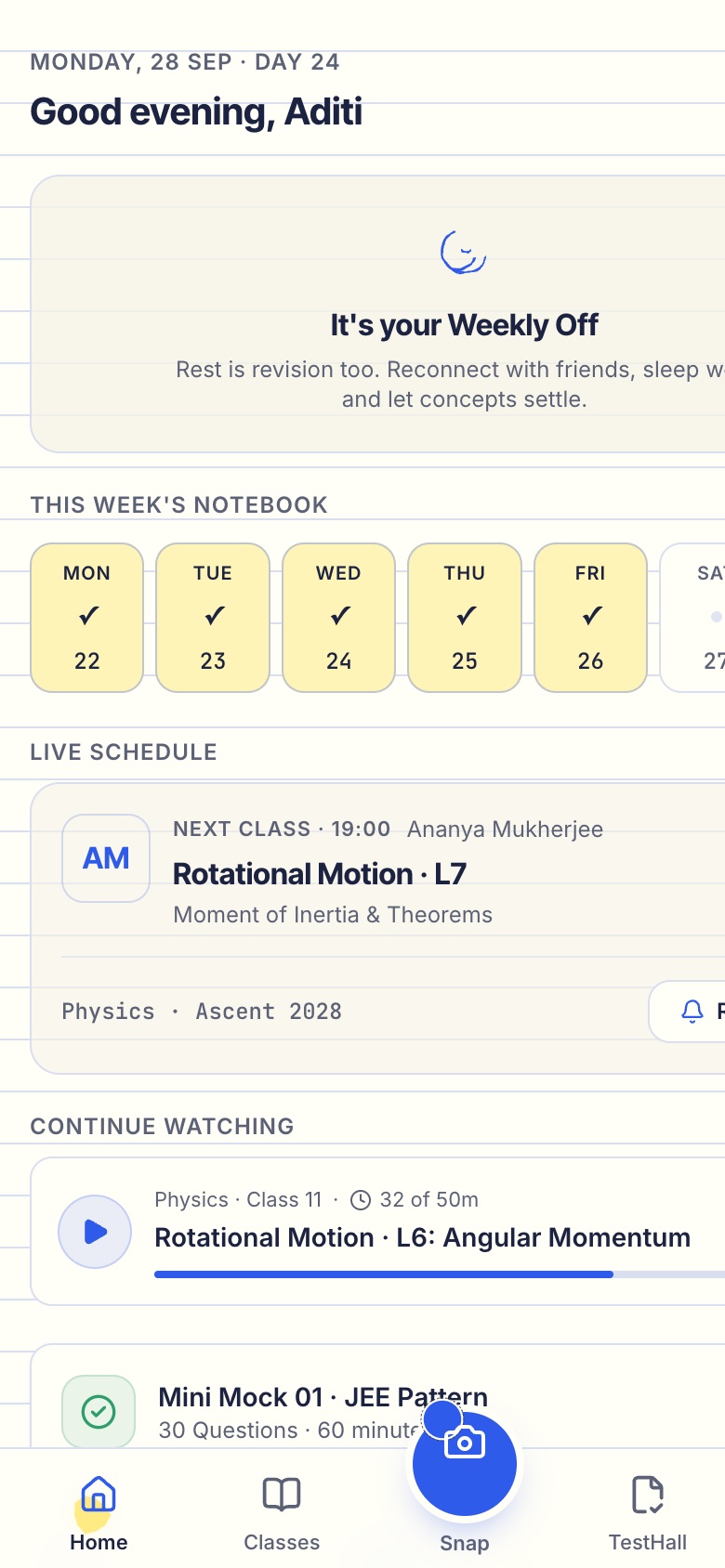
That is the moment for a proper scheduling and learning app: students book and reschedule slots, pay fees, get practice assignments and rewatch recorded lessons, while teachers see their day and log progress. Our concept build RankUp is an exam-coaching platform, not a music school, but its batches, live online classes and progress tracking are the same pieces a music school needs, especially if you teach students in other cities. Our edtech app guide explains the options, the page on online learning apps lists what goes into one, and you can send us a brief for a fixed quote.
See the app a music school runs on
We designed and built this concept end to end, every side of it, so you can open it and try it before you plan your own. Our edtech app page covers the features, timeline and what moves the cost.
Questions people ask
How much does it cost to open a music school in India?
Roughly ₹6–15 lakh for a three-room school in a tier-2 city, and ₹30–70 lakh for a larger metro school with six to eight treated rooms. The biggest items are the rent deposit, soundproofing, instruments and teacher pay for the first months. Students often bring their own instruments, which keeps the starting stock smaller.
Do I need a licence to teach music?
No special licence is needed to teach music, but the school itself needs the normal registrations: Shop & Establishment, a trade licence and GST when your turnover calls for it. Public recitals using recorded music may need copyright licences, and teachers working with children should be police-verified. Check your state's rules with a CA.
Should my music school offer graded exams?
Offering graded exams is worth it for many schools, because parents like certificates and students like clear goals. Affiliating with a recognised board gives you a ready syllabus and a twice-yearly calendar to work towards. It adds admin and exam fees, so introduce it once your teaching is steady rather than in the first month.
How do I keep sound from disturbing neighbours?
Choose the right space first: ground floors, commercial buildings and rooms away from bedrooms help most. Then add door seals, insulation, acoustic panels and a floating floor for the drum room. Test with a drum kit before you sign the lease, and keep the loudest lessons to sensible hours.
Can a music school teach online too?
Yes, and many do. Live video lessons work well for vocals, keyboard and theory, and they let you keep students who move cities. You need reliable scheduling and payments, good audio on both ends, and recorded lessons students can revisit. Try it with your existing students before you market online classes widely.


