The short answer
Decide first whether you will run a franchise of a national courier network or build your own local delivery service, because the two need very different money, skills and systems. A franchise gives you a known name and intercity reach from day one; your own intracity network keeps more of the margin but makes you answerable for every rider, route and lost parcel. There is no single courier licence for domestic parcels, but GST, vehicle registration and e-way bill rules still apply.
As a ballpark, a franchise counter or a small city service with four or five riders in a tier-2 city needs about ₹3.5–9 lakh. Your own metro network with a sorting hub, vans and a rider team often needs ₹25–55 lakh. This guide covers the models, registrations, costs, steps, daily operations, customers and tech.
Is a courier business right for you?
Online sellers, pharmacies, labs, law firms, small manufacturers and ordinary households send parcels and documents every day. Courier demand rises with online selling, and same-day delivery within a city, for shops, restaurants and home businesses, is a growing niche. Large networks dominate intercity parcels, so small operators usually win on local speed, convenient pickups and attention to senders the big networks treat as too small.
It suits operators: people who enjoy routes, schedules and logistics more than branding. You will manage riders and drivers, handle cash on delivery carefully, and need to stay calm when a parcel goes missing and the sender is on the phone.
The hard parts are thin margins per parcel, returns from online orders, rider attrition, breakdowns, cash-on-delivery reconciliation, and claims for loss or damage. Volume is everything: a route with too few parcels loses money however well it is run.
Business models to choose from
| Model | How it works | Suits |
|---|---|---|
| National network franchise | You run a booking counter or area franchise, picking up and delivering for an established network | First-time founders who want a known name and intercity reach |
| Same-day city delivery | Riders on bikes deliver within the city in hours, booked by phone, WhatsApp or app | Shops, restaurants, pharmacies and online sellers |
| Intracity B2B logistics | Scheduled pickups and drops for businesses using three-wheelers and mini-trucks | Wholesalers, distributors and manufacturers |
| Last-mile delivery partner | You run deliveries in one area on contract for bigger courier or e-commerce networks | Founders with riders and local knowledge but little capital |
| Document and legal courier | Time-bound delivery of papers to courts, offices and banks | Areas dense with offices and legal practices |
Many owners begin with a franchise or a last-mile contract to learn the work and build a rider team, then add their own same-day service for local businesses. If you plan to carry household goods or full loads rather than parcels, read how to start a packers and movers business or a transport business instead.
Licences and registrations
| Registration | Why you need it | Where you get it |
|---|---|---|
| Business registration | A proprietorship works for a franchise; an LLP or company suits a growing network | Ministry of Corporate Affairs, or a bank current account for proprietors |
| GST registration | Needed above the turnover limit, and usually required by franchisors and business clients | GST portal |
| Shop & Establishment registration | For your office, booking counter or hub | State labour department or municipal body |
| Commercial vehicle registration and permits | Vans, three-wheelers and, in some states, bikes used for paid delivery must be registered for commercial use | Regional Transport Office (RTO) |
| E-way bill compliance | Goods consignments often need an e-way bill depending on value and route; transporters without GST can enrol for a transporter ID | GST e-way bill portal |
| Insurance | Goods-in-transit cover for parcels, plus commercial vehicle insurance | General insurers |
| EPF and ESI | Once your headcount brings you under them; check how gig riders are treated under the labour codes | EPFO and ESIC |
For domestic parcels there is no single courier licence. The newer Post Office Act no longer gives the postal department an exclusive privilege over carrying letters, which clears up an old grey area for document couriers, but confirm the current position if letters are central to your service. Publish a prohibited items list covering cash, valuables you cannot insure, flammable or hazardous goods, drugs and weapons, and treat air and international shipments separately, as they carry extra security and customs rules.
Vehicle permits, e-way bill rules and labour code coverage for delivery riders vary by state and change often. Confirm what applies to your model with a CA or transport consultant. This is not legal advice.
What it costs to start
| Item | Small start | Larger setup |
|---|---|---|
| Franchise deposit or own branding | ₹50,000–2 lakh | ₹1–3 lakh |
| Counter or hub space (deposit and fit-out) | ₹50,000–1.5 lakh | ₹4–8 lakh |
| Vehicles (bikes, a three-wheeler or used vans) | ₹1–2 lakh | ₹10–20 lakh |
| Weighing scale, scanners, label printer and racks | ₹20,000–50,000 | ₹1.5–3 lakh |
| Packaging stock and branded bags | ₹15,000–40,000 | ₹1–2 lakh |
| Insurance and registrations | ₹20,000–50,000 | ₹1–3 lakh |
| Rider wages and fuel for the first two months | ₹80,000–1.5 lakh | ₹6–10 lakh |
| Booking and tracking software, launch marketing | ₹20,000–60,000 | ₹2–5 lakh |
| Rough total | ₹3.5–9 lakh | ₹25–55 lakh |
Price per parcel by weight and distance, with clear extra charges for cash on delivery, returns and same-day slots. Cash collected on delivery belongs to your senders: remit it on the agreed cycle and never use it to fund operations, or one slow month will turn into a crisis.
Ballpark planning ranges only, not quotes. Franchise terms in particular differ widely between networks.
Step by step: from idea to first customer
- Choose franchise or own network, and if franchising, compare the revenue share, deposit and territory rules of several networks.
- Map your area: where the senders are (markets, offices, home sellers) and how long routes take at peak hours.
- Register the business, open a current account and apply for GST.
- Register vehicles for commercial use at the RTO and buy goods-in-transit insurance.
- Set rates and service levels: delivery windows, pickup cut-off times, weight slabs and COD charges.
- Hire riders and verify them, checking driving licences, then train them on handling, OTP delivery and talking to customers.
- Set up the counter or hub with racks, a scale, a label printer and a sorting area.
- Write a prohibited items list and a claims policy, and show both at booking.
- Run trial routes for a week with your own parcels and those of friendly businesses.
- Sign the first business clients and promise only the delivery times you have already achieved in trials.
Running it day to day
Mornings start at the hub. Parcels arriving from the network or from overnight pickups are scanned, sorted by route and loaded. Riders go out with a route list and come back for a second run after lunch, and afternoons go to pickups from regular senders. The day ends by matching every parcel scanned out against delivered, returned or failed, and every rupee of COD against the parcel list.
- Failed deliveries: call the customer before the rider arrives, because a second attempt costs as much as the first.
- Proof of delivery: OTP, signature or photo for every parcel, since disputes surface weeks later.
- Rider safety: helmets, rain gear and realistic targets. Rushed riders crash and damage parcels.
- COD discipline: collect and deposit cash daily, and settle with senders on a fixed cycle.
- Vehicle upkeep: a weekly check of tyres, brakes and lights prevents most breakdowns.
Getting your first customers
Your strongest early customers are businesses that ship often and complain about their current service. Walk through markets and talk to sellers packing parcels at the counter, pharmacies that need same-day drops, and labs that move samples and reports. Offer a pickup at a fixed time every day: reliability sells better than a lower rate.
- Online sellers: home businesses and small brands need doorstep pickups and help with returns; solve both.
- Local shops and restaurants: same-day delivery across the city for orders taken by phone or WhatsApp.
- Offices and law firms: document runs to courts, banks and government offices.
- Network partnerships: last-mile contracts for larger couriers can fill your riders' spare capacity.
- Google Business Profile: list your counter with pickup hours and service areas so walk-in senders find you.
The tech you need
To begin, you need booking with a printed label and tracking number, a way to share tracking with the recipient, proof of delivery on the rider's phone, COD records and GST invoicing. A franchise usually provides its own booking system for network parcels, but you still need your own tools for local work. Our logistics app guide and hyperlocal delivery guide explain the options.
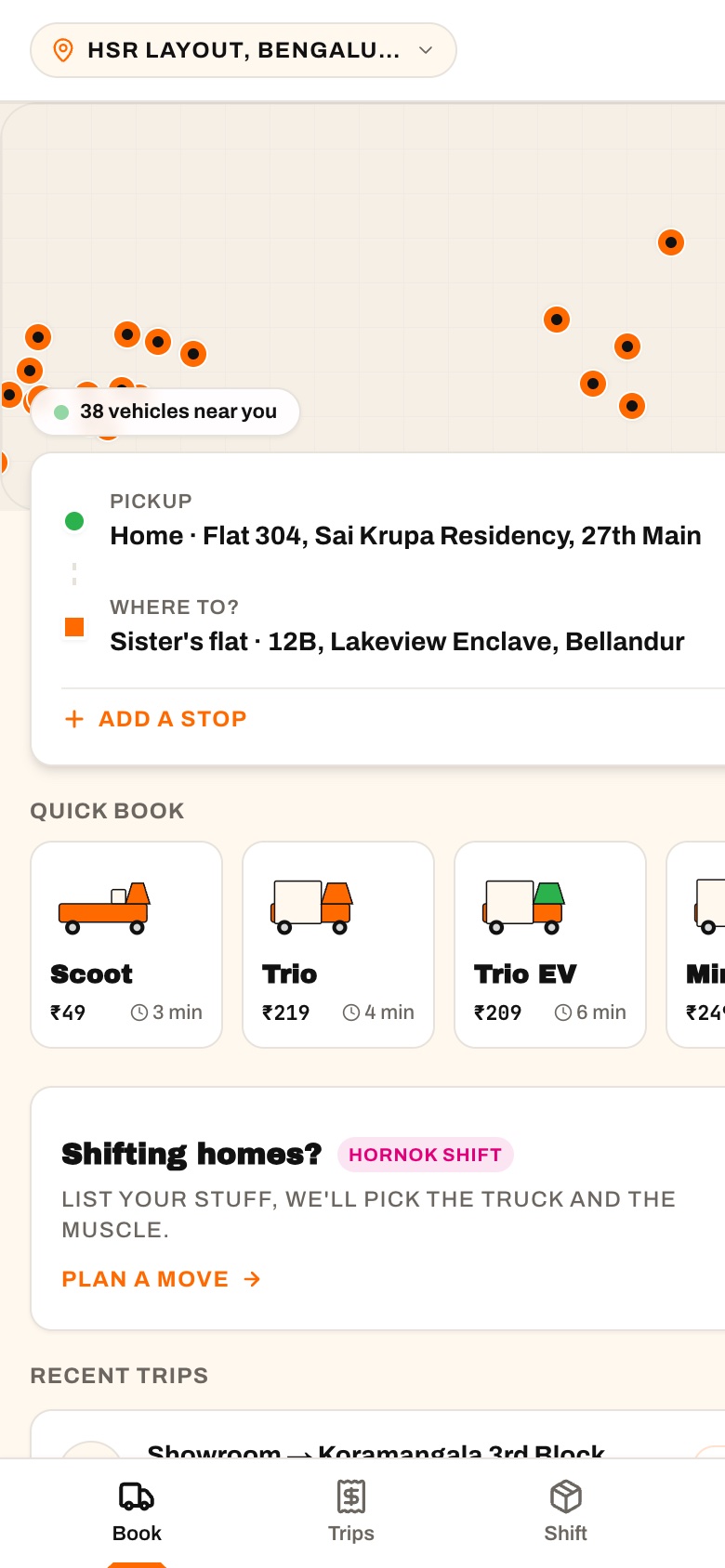
Our concept build HornOK is intracity logistics for mini-trucks, three-wheelers and bikes, with a customer app, a driver app and a dispatch dashboard on maps. Booking by vehicle type, driver assignment and live tracking map directly onto a city courier service; multi-parcel route batching, hub scanning and COD settlement would be added for parcel volumes. See what a logistics app involves, or send us a brief for a fixed quote.
See the app a courier business runs on
We designed and built this concept end to end, every side of it, so you can open it and try it before you plan your own. Our logistics app page covers the features, timeline and what moves the cost.
Questions people ask
Do I need a licence to start a courier business in India?
There is no single licence for carrying domestic parcels. You need business registration, GST, Shop & Establishment for your premises, commercial registration for delivery vehicles, insurance, and e-way bill compliance for goods consignments where it applies. Under the Post Office Act 2023 the postal department no longer has an exclusive privilege over letters, but check the current rules for your service.
How much does it cost to start a courier business?
A franchise counter or a small city service with four or five riders in a tier-2 city usually needs about ₹3.5–9 lakh, including vehicles, the counter, equipment and two months of rider wages. Your own metro network with a hub, vans and 20 or more riders often needs ₹25–55 lakh. These are planning ballparks, not quotes.
Is a courier franchise better than starting my own?
A franchise is usually easier for a first business, because the network brings a known name, intercity reach and a booking system, while you earn a share of each parcel. Your own network keeps more margin and lets you set prices, but you carry every cost and risk. Many founders start with a franchise and add a local same-day service later.
What items can a courier refuse to carry?
You can and should refuse anything illegal or unsafe: cash, drugs, weapons, explosives, flammable liquids and gases, hazardous chemicals, and valuables you cannot insure. Air shipments have stricter rules on batteries and liquids. Publish your prohibited list at booking, inspect parcels where you can, and record the sender's ID for every booking.
How do courier businesses earn money?
They charge per parcel based on weight, size, distance and speed, plus fees for cash on delivery, returns, pickups and insurance. Franchisees earn a share of booking revenue and delivery fees set by the network. Profit depends on route density: the more parcels a rider delivers per trip, the lower the cost of each delivery.


