The short answer
Validate before you incorporate. Talk to twenty or more people who have the problem, and get a few to pay, sign a letter of intent or join a waitlist. Then register a private limited company through the MCA's SPICe+ form, sign a founder agreement with vesting, and build the smallest product that tests your riskiest assumption. Apply for DPIIT recognition once you are incorporated, and fund the first months yourselves if you can.
As a ballpark, two founders building a first version from home can reach launch for roughly ₹7–20 lakh, including modest living costs for about six months. A funded team of five to eight in a metro can spend ₹50 lakh to ₹1.2 crore in its first year. This guide covers business models, registrations, costs, the steps from idea to first customer, and the tech you need.
Is a tech startup right for you?
India has hundreds of millions of people online, near-universal UPI payments, and small businesses that are moving their work to phones. That creates room for software that solves real problems for Indian users, whether they are shopkeepers, farmers, students or office teams. The opportunity is real, but most startup ideas fail because not enough people want them, not because the code was weak.
It suits founders who know a problem from the inside, can live with uncertainty for a long time, and are comfortable selling. At least one founder should be able to build the product or manage a build partner closely. Expect to do customer support, sales, hiring and accounts yourselves for the first year.
The hard parts: running out of money before you find demand, co-founder disagreements over equity and direction, hiring engineers you can afford, and staying focused when every customer asks for something different. Plan for each from day one.
Business models to choose from
| Model | How it works | Suits |
|---|---|---|
| SaaS for businesses | Software sold to businesses on a monthly or yearly subscription | Founders who know an industry's workflow |
| Consumer app | A free or freemium app that earns from subscriptions, ads or transactions | Teams that can grow users cheaply and keep them |
| Marketplace | Connects buyers and sellers and earns a commission or fee | Founders who can build both sides of supply and demand |
| Tech-led D2C brand | Sells its own products online, with technology as the edge | Founders with product and marketing skills |
| Services first, product later | Starts as a service or agency and turns repeated work into a product | Bootstrapped founders who want revenue early |
| Deep tech or hardware | Builds new technology or devices, often with long research cycles | Teams with specialist knowledge and patient funding |
Your model decides how you raise money, how fast you can grow and how you sell. Business software can often be bootstrapped from early customers, while consumer apps and marketplaces usually need outside funding to reach scale. If your idea is closer to a product brand than a platform, read our playbook on starting a D2C brand too.
Licences and registrations
| Registration | Why you need it | Where you get it |
|---|---|---|
| Private limited company | The structure most investors expect; an LLP can suit bootstrapped businesses | MCA portal, through the SPICe+ incorporation form |
| Digital signatures and DIN | Directors need them to sign incorporation and annual filings | Certifying authorities, with DIN allotted through SPICe+ |
| PAN and TAN | Issued to the company along with incorporation | Through SPICe+ |
| GST registration | Needed once your turnover or the type of sales requires it, and often taken early for business customers | GST portal |
| DPIIT recognition | Startup India recognition gives access to certain benefits and schemes, which change over time | Startup India portal |
| Shop & Establishment registration | For an office with employees, under your state's law | State labour department or municipal body |
| Trademark | Protects your product name and logo | Trade Marks Registry, through IP India |
| Founder agreement and ESOP pool | Sets equity, vesting, roles and exits, and reserves shares for future employees | Drafted with a startup lawyer and approved by the board and shareholders |
| DPDP Act compliance | Rules for consent, notices, security and deletion when you handle personal data | Under the Digital Personal Data Protection Act and its rules |
Professional tax applies in some states, and EPFO and ESIC registration follow once your team reaches the size the law sets. A company also has annual filings with the Registrar of Companies, statutory audits and board meetings to record, so appoint a CA from the start. If your product handles personal data, our DPDP Act checklist explains what to build in.
Company law, tax rules and Startup India benefits change. Confirm the current position with a CA and a company secretary or lawyer before you rely on any benefit. This is not legal advice.
What it costs to start
| Item | Small start | Larger setup |
|---|---|---|
| Incorporation, CA and first-year compliance | ₹40,000–1 lakh | ₹1–3 lakh |
| Trademark, founder agreement, terms and privacy policy | ₹20,000–60,000 | ₹1–3 lakh |
| First version design and build (market range) | ₹3–10 lakh | ₹15–40 lakh |
| Cloud, domains and software tools | ₹20,000–60,000 | ₹1–4 lakh |
| Workspace | Home or a few co-working days, up to ₹60,000 | ₹3–8 lakh |
| Customer research and launch marketing | ₹30,000–1 lakh | ₹3–10 lakh |
| Founder or team salaries for six months | ₹3–6 lakh | ₹25–50 lakh |
| Rough total | ₹7–20 lakh | ₹50 lakh–1.2 crore |
The build line is a market range for a first version, not a price from us; our guide to app development cost in India explains what moves it. The line that decides survival is runway, meaning how many months you can pay yourselves and your costs before revenue or funding arrives. Count it every month.
These are ballpark figures to sanity-check a plan, not quotes. Costs depend on your product, team, city and how much you build yourselves.
Step by step: from idea to first customer
- Write down the problem, the customer and the riskiest assumption in one page before you write any code.
- Interview twenty or more potential customers about how they solve the problem today and what it costs them.
- Test demand cheaply: a landing page with a waitlist, a manual version of the service, or a paid pilot.
- Agree on the founding team: equity split, vesting with a cliff, roles and what happens if someone leaves, in a signed agreement.
- Incorporate through SPICe+, open a current account, and set up GST if your customers need tax invoices.
- Apply for DPIIT recognition and check which benefits apply to you now.
- Scope the first version (MVP) around one user journey and cut every feature that does not test your assumption.
- Build it yourselves or with a fixed-scope partner, with weekly demos so you see progress early.
- File your trademark and publish terms of use and a privacy notice that match what the product actually does.
- Launch to your waitlist and pilot customers, watch how they use it, and talk to them every week.
- Decide on funding once you have usage or revenue to show: keep bootstrapping, approach angels, or apply to grant schemes.
Running it day to day
An early startup runs on a weekly rhythm. Monday sets the week's priorities from what customers said. Most days mix building, customer calls and support. Every week ends with a small release and a look at a handful of numbers: active users, retention, revenue and cash left. Monthly, the CA files GST returns and TDS, and every quarter the founders should review runway honestly.
- Talk to users every week: sales calls, support chats and short interviews keep the product honest.
- Ship small and often: a release every week or two beats a big launch every quarter.
- Track runway: know how many months of cash you have and start raising or cutting well before it runs low.
- Keep compliance on a calendar: GST, TDS, board minutes and annual ROC filings are easy to miss and expensive to fix.
- Funding routes: bootstrapping with early revenue, friends and family, angel investors and angel networks, incubators, and government seed and grant schemes run through recognised incubators and state startup policies. Each comes with different expectations.
Getting your first customers
Your first customers rarely come from ads. They come from founders selling directly: calling people you interviewed, demoing in person, and staying close to every early user. Do things that do not scale, such as onboarding each user yourself, and learn from every conversation. Our guide to getting your first users after launch goes deeper.
- Your interview list: the people you spoke to during validation are your warmest leads.
- Communities: industry associations, WhatsApp and Telegram groups, and online forums where your users already gather.
- Pilots with businesses: offer a short paid pilot with clear success measures instead of a long free trial.
- Content: write honestly about the problem you solve; it builds trust and search traffic over time.
- A clear name and story: a memorable brand helps every conversation; our startup branding guide covers the basics.
The tech you need
On day one you need a domain, a professional email, a simple landing page with a waitlist, analytics and a way to take payments, usually a payment gateway with UPI. The first version comes next. Keep it to one main user journey, built on standard tools, so you can change direction without throwing everything away. Our MVP guide for Indian startups explains how to scope it.
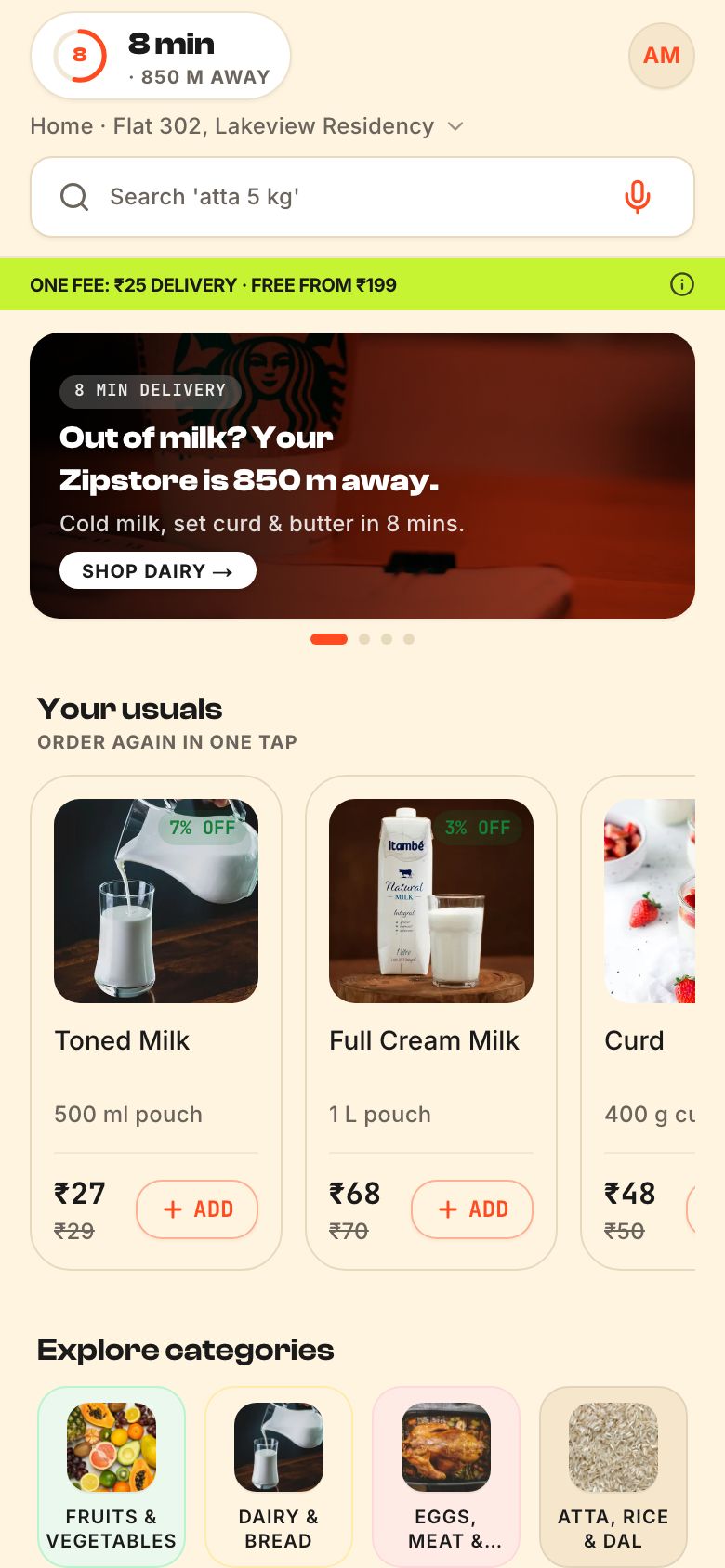
Our concept build Zippit, a neighbourhood quick-commerce marketplace where many local shops share one cart and one runner, shows how scoping works. The full concept has shop, customer and runner apps plus an operations dashboard. A first version would cover one neighbourhood and a handful of shops, a single checkout with UPI, a runner app that only accepts, picks up and delivers, and an admin panel for manual fixes. Read what a marketplace app involves, see how we work, or send us a brief for a fixed quote within 48 hours.
See the app a tech startup runs on
We designed and built this concept end to end, every side of it, so you can open it and try it before you plan your own. Our marketplace app page covers the features, timeline and what moves the cost.
Questions people ask
How do I register a startup in India?
Most tech startups incorporate a private limited company through the SPICe+ form on the MCA portal, which also issues the company's PAN and TAN. Directors need digital signatures. After incorporation, open a current account, register for GST if needed, and apply for DPIIT recognition on the Startup India portal. A CA or company secretary can handle the filings.
What is DPIIT recognition and should I apply?
DPIIT recognition is the government's official recognition of a startup under Startup India. It can give access to benefits such as easier compliance, support with intellectual property and eligibility for some schemes and tax provisions, some of which need separate approval. The benefits change over time, but applying is free and usually worth doing soon after incorporation.
How much money do I need to start a tech startup?
Two founders building a first version from home can often reach launch with roughly ₹7–20 lakh, including modest living costs for six months. A funded team in a metro can spend ₹50 lakh to ₹1.2 crore in its first year. Your runway, not your build cost, is the number that decides how long you can keep going.
Do I need a technical co-founder?
Not always, but it helps a lot. A technical co-founder can build quickly, judge trade-offs and hire engineers. Without one, you can work with a fixed-scope build partner for the first version, but you still need to understand the product deeply, write clear requirements and own decisions. Many non-technical founders add a technical co-founder or early hire after the MVP.
How do early-stage startups in India get funding?
Most start with their own savings, early revenue, or friends and family. Once there is traction, angel investors and angel networks are common sources of a first cheque, and incubators often offer small grants or seed support. Government seed and grant schemes, usually run through recognised incubators and state startup policies, can also help. Venture funding generally comes later.


