The short answer
You can start a home bakery with an oven, a few good recipes and FSSAI registration. Begin with a small menu — celebration cakes, brownies, cookies or breads — take orders from people who already know you, and price every item properly from the first order, including your time and packaging.
As a ballpark, a home setup can start for roughly ₹50,000–2 lakh. Moving into a small bake studio with a counter often needs ₹5–12 lakh. Most home bakers grow through repeat orders and word of mouth, so consistency matters more than variety.
Is a home bakery right for you?
Birthdays, anniversaries, festivals and office celebrations keep custom cakes and dessert boxes in steady demand across India, and many customers prefer a baker they know over a chain. A home bakery lets you test that demand with little money and keep your day job while you learn.
It suits people who enjoy baking at volume, not just for fun, and who can say no to an order they cannot deliver well. The hard parts: deadline pressure around festivals, delivering fragile cakes safely, kitchen space at home, and pricing — many home bakers undercharge for months before they notice they are working for free.
Business models to choose from
| Model | How it works | Suits |
|---|---|---|
| Custom cakes to order | Celebration and theme cakes, booked days ahead | Bakers with decorating skills |
| Dessert boxes and gifting | Brownies, cookies, cupcakes in branded boxes | Festive and corporate orders; easier to deliver |
| Breads and healthy bakes | Sourdough, millet and eggless bakes on a weekly schedule | Health-conscious neighbourhoods; good for subscriptions |
| Bake studio with a counter | A small shop with fresh bakes and pre-orders | Home bakers with steady demand ready to scale |
| Supply to cafes | Wholesale bakes to local cafes and offices | Bakers who can produce consistently in volume |
Licences and registrations
| Registration | Why you need it | Where you get it |
|---|---|---|
| FSSAI registration or licence | Required for anyone selling food, including from home | Food Safety and Standards Authority of India, online |
| GST registration | Needed once you cross the turnover limit, or to sell through some platforms | GST portal |
| Shop & Establishment registration | Needed when you open a shop or hire staff, under state law | State labour department or municipal body |
| Trade licence | Needed for a shop or studio, and in some cities for home businesses | Municipal corporation |
| Packaged food labelling | If you sell packed, labelled products, labelling rules apply | Follow FSSAI and legal metrology rules for packaged goods |
| Udyam registration | Optional; records you as a micro enterprise for loans and schemes | Udyam portal |
Check your housing society's rules too. Most do not object to small home businesses, but deliveries at all hours and a commercial oven can cause friction.
Rules and thresholds vary by state and change. Confirm what applies to you with a CA or the local authority. This is not legal advice.
What it costs to start
| Item | Small start | Larger setup |
|---|---|---|
| Oven and mixer | ₹20,000–60,000 | ₹1.5–4 lakh (deck or convection oven) |
| Tins, tools, turntable and piping kit | ₹10,000–30,000 | ₹50,000–1 lakh |
| Fridge or display chiller | Use your home fridge | ₹50,000–1.5 lakh |
| Packaging: boxes, boards, labels | ₹5,000–20,000 | ₹50,000–1 lakh |
| FSSAI registration and basic paperwork | Small | ₹20,000–60,000 with CA help |
| Shop rent deposit and fit-out | — | ₹2–5 lakh |
| Photos, website and launch | ₹5,000–30,000 | ₹50,000–1.5 lakh |
| Rough total | ₹50,000–2 lakh | ₹5–12 lakh |
Price every product from its full cost: ingredients, packaging, gas or electricity, delivery, and your hours. Then add margin. Custom cakes usually take longer than bakers expect, so charge for design time.
These are ballpark estimates to sanity-check a plan, not quotes.
Step by step: from idea to first customer
- Choose five to eight products you can make perfectly every time, including at least one eggless option.
- Cost and price each one, and write a price list with sizes and lead times.
- Apply for FSSAI registration before you take paid orders.
- Photograph your bakes in natural light. Good photos sell cakes.
- Set order rules: advance payment by UPI, minimum notice, delivery charges and a cancellation policy.
- Sort delivery: cake boxes with boards, and a delivery person or local courier who carries cakes flat.
- Start with friends, family and colleagues, and ask each happy customer for a review and a referral.
- Set up a WhatsApp Business catalogue with your price list.
- Create a Google Business Profile if your area allows a home-based listing.
- Plan festive menus a month ahead and cap the number of orders you accept.
Running it day to day
A home bakery runs on a weekly calendar. Orders come in on WhatsApp, sponges are baked a day ahead, decorating happens on the day, and deliveries are timed around the celebration. Keep one calendar for every order, with the flavour, message, size and delivery time.
- Ingredients: buy butter, cream and chocolate from a reliable wholesaler and store them properly.
- Hygiene: separate baking equipment from home cooking, label allergens and keep eggless orders separate.
- Capacity: know how many cakes you can finish in a day and stop taking orders beyond that.
- Money: take full or part payment in advance; it ends no-shows.
Festive weeks need their own plan. Fix a festive menu of a few products that can be made ahead, open bookings early, close them when you reach capacity, and line up extra help for packing and delivery. A calm festive season with fewer, perfect orders earns more repeat customers than a chaotic one with late cakes.
Getting your first customers
Your first fifty customers will come from people you know and the people they tell. After that, local search helps: a Google Business Profile with photos and reviews brings in people searching for a cake near them. Our local SEO guide explains the setup.
- Housing societies: a tasting table at a society event can fill your festive calendar.
- Offices: pitch birthday cakes and festive boxes to HR teams nearby.
- Cafes: supply a few bakes to a local cafe; see how to start a cafe.
- Social media: short videos of decorating do well; always include how to order.
The tech you need
At the start, a WhatsApp Business catalogue, a UPI QR and a shared calendar are enough. As orders grow, typing the same details into chat for every cake becomes the bottleneck. A simple website where customers choose size, flavour, message and delivery slot, and pay in advance, saves hours each week. Our guide on WhatsApp for business shows where chat fits alongside a site.
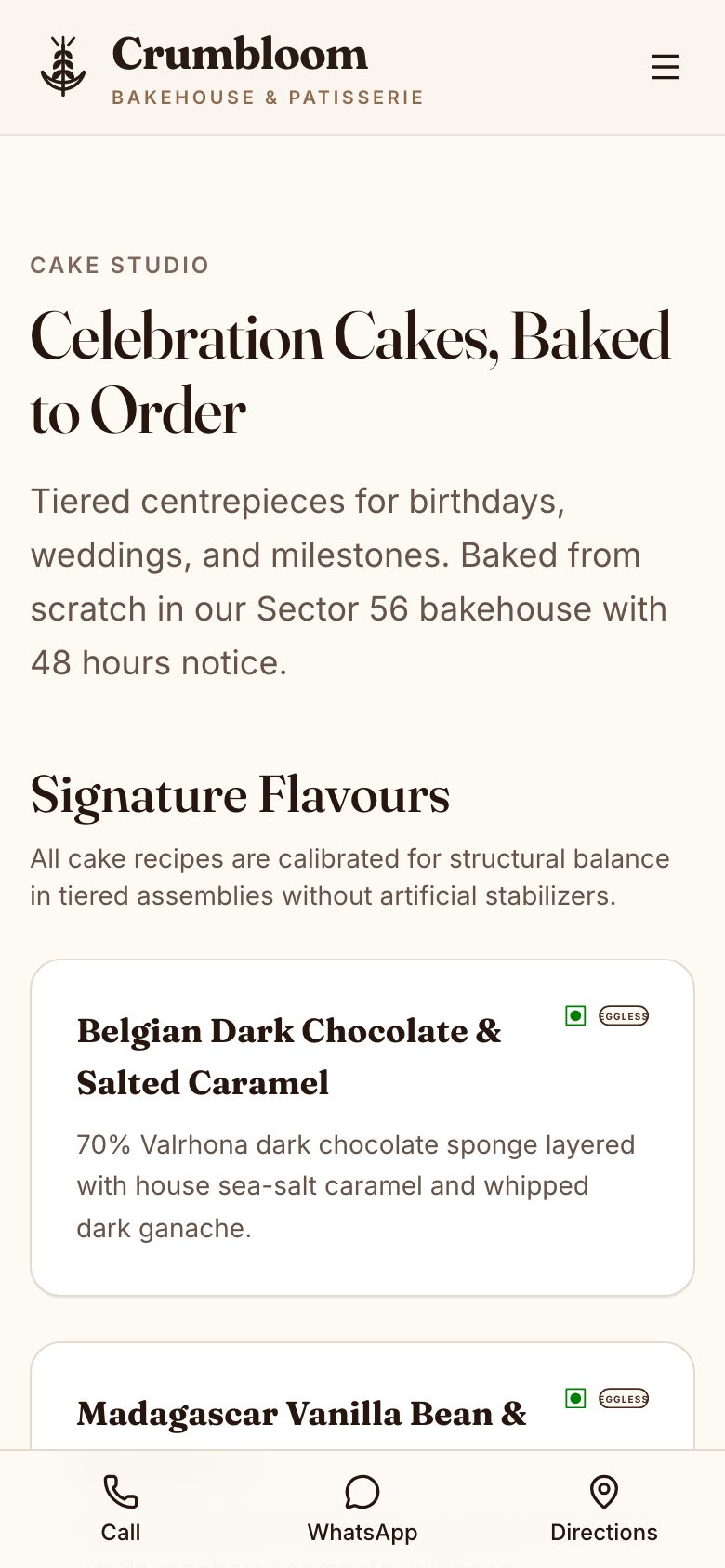
Our concept build Crumbloom shows where a bakery can go: a custom cake builder, a live bake timetable showing when fresh bread comes out of the oven, and a pastry box builder with bundle pricing. See what a bakery or restaurant website involves, or a simpler business website.
See the app a home bakery runs on
We designed and built this concept end to end, every side of it, so you can open it and try it before you plan your own. Our restaurant website and qr ordering page covers the features, timeline and what moves the cost.
Questions people ask
Do I need a licence to sell cakes from home in India?
Yes. Anyone selling food, even from a home kitchen, needs FSSAI registration, and a licence once the business is larger. GST registration is needed when you cross the turnover limit. Some cities also want a trade licence. Confirm what applies to you with a CA or the local food safety office.
How much money do I need to start a home bakery?
As a ballpark, ₹50,000 to ₹2 lakh covers a good oven, a mixer, tools and packaging if you bake at home. Moving into a small studio with a counter usually needs ₹5–12 lakh. Start at home, prove demand, then scale.
How should I price custom cakes?
Add up ingredients, packaging, gas or electricity and delivery, then add your hours at a fair rate and a margin on top. Charge more for complex designs and short notice. Many home bakers price by weight plus a design charge, which keeps pricing clear for customers.
Can I sell my bakes on food delivery apps?
Some platforms list home bakers, but they usually want FSSAI and GST details, and commissions are high on small orders. Many home bakers do better with direct orders on WhatsApp and their own website, using platforms only for discovery.
Does a home bakery need a website?
Not on day one; a WhatsApp catalogue works. Once you get regular orders, a simple website with your menu, a cake order form and advance payment saves time and looks more trustworthy to new customers who find you on Google.


