The short answer
A supermarket needs three things to work: a location with enough households nearby, a range that matches what those households buy, and tight control of stock and staff. Start with a modest format, get your systems right, and add delivery once the store runs smoothly.
It is a capital-heavy, high-volume business. Rent, stock and staff are your biggest costs, and margins are modest, so planning matters more than in most small businesses. This playbook covers formats, licences, costs, launch steps and the tech that keeps it all counted.
Is a supermarket right for you?
Families in Indian cities and growing towns increasingly like to browse, compare brands and pick their own vegetables, while still wanting the familiarity of a local store. A well-run neighbourhood supermarket sits between the small kirana and the large hypermarket.
People who succeed here have retail experience or hire it early. They are strong on systems: stock counts, supplier terms, staff schedules and daily cash. They also have enough capital to survive the first months while the store builds a habit in its area.
The hard parts: high rent for a good location, large stock investment, shrinkage (theft, damage, expiry), staff turnover and price comparisons with online platforms. A supermarket that runs out of basics or has long billing queues loses customers quickly.
Business models to choose from
| Model | How it works | Suits |
|---|---|---|
| Neighbourhood supermarket | 1,500–4,000 sq ft, groceries, fresh produce and household items | Dense residential areas |
| Fresh-led store | A bigger fresh section — fruit, vegetables, dairy, bakery — drives footfall | Owners with good sourcing |
| Franchise format | A branded store with supply chain and systems, in return for fees | First-time retailers wanting a proven playbook |
| Store plus online orders | The store doubles as the pick point for local delivery | Areas with many working households |
| Speciality or regional | Focus on a community’s foods, organic products or imported goods | Clear niche customer groups |
Licences and registrations
| Registration | Why you need it | Where you get it |
|---|---|---|
| Shop & Establishment registration | Registers the store, staff and working hours under state law | State labour department |
| Trade licence | Permission to run retail trade at the premises | Municipal corporation or local body |
| FSSAI licence or registration | You store and sell food; the level depends on scale | FSSAI’s FoSCoS portal |
| GST registration | Supermarket turnover usually crosses the threshold; needed for invoices and input credit | GST portal, through a CA |
| Legal metrology | Weighing scales must be verified; packing loose goods in-store brings labelling rules | State legal metrology department |
| Fire safety clearance | Often required depending on floor area, building and local rules | Local fire department |
| Signboard permission | Some cities regulate shop signage | Municipal body |
| Labour registrations | Provident fund and ESI may apply once you employ enough staff | EPFO and ESIC portals |
Requirements and thresholds vary by state, city and store size, and they change. Confirm with a CA, a licensing consultant or the local authority. This is general guidance, not legal advice.
What it costs to start
| Item | Small start (~1,500 sq ft) | Larger setup (~4,000 sq ft) |
|---|---|---|
| Rent deposit and advance | ₹3 lakh – ₹8 lakh | ₹8 lakh – ₹20 lakh |
| Interiors, racks, lighting, signage | ₹6 lakh – ₹15 lakh | ₹20 lakh – ₹45 lakh |
| Opening stock | ₹8 lakh – ₹15 lakh | ₹25 lakh – ₹50 lakh |
| Refrigeration (chillers, freezers) | ₹2 lakh – ₹5 lakh | ₹6 lakh – ₹15 lakh |
| Billing counters, scanners, software, CCTV | ₹1.5 lakh – ₹4 lakh | ₹4 lakh – ₹10 lakh |
| Power backup | ₹1 lakh – ₹3 lakh | ₹3 lakh – ₹8 lakh |
| Working capital (3 months) | ₹4 lakh – ₹8 lakh | ₹12 lakh – ₹25 lakh |
These are planning estimates, not quotes. Rent, interiors and stock depth vary widely; get written quotes from landlords, fit-out contractors and distributors before you commit.
Step by step: from idea to first customer
- Map the catchment. Count housing societies, offices and competing stores within a 1–2 km radius.
- Decide the format and range. Neighbourhood, fresh-led or speciality; draft your category list.
- Secure the premises. Ground floor, parking or easy drop-off, space for a stock room and loading.
- Get licences moving early. Fire and trade licences can take time; start while interiors are being done.
- Plan the layout. Fresh near the entrance, staples at the back, impulse items near billing.
- Sign suppliers. FMCG distributors, staples wholesalers, a fresh produce source and local dairy.
- Set up systems. Billing with barcode scanning, stock management, CCTV and a daily cash process.
- Hire and train staff. Cashiers, floor staff and a store manager; train on billing, shelf filling and customer service.
- Run a soft opening. A few days for friends and nearby residents to find problems before the official launch.
- Launch and listen. Ask customers what’s missing and track queue times at peak hours.
Running it day to day
Shrinkage is the silent cost. Theft, damage, expiry and billing errors can wipe out a month’s profit. Weekly cycle counts of high-value items, CCTV, near-expiry checks and clear returns processes keep it in check.
Fresh needs its own routine. Receive produce early, sort and display it, and mark down items before they spoil. A fresh section that looks tired by evening hurts the whole store.
Queues lose customers. Plan counters and staff for evening and weekend peaks. Fast barcode scanning and UPI at every counter matter more than decoration.
Supplier terms drive cash flow. Negotiate credit days, schemes and returns for expiry. Pay on time to keep those terms.
Close every day properly. Reconcile cash, cards and UPI, review sales by category, and note stock-outs for tomorrow’s orders.
Staff make or break the store. Cashiers and floor staff are the people customers actually meet. Fixed shifts, clear duties for each aisle, short daily briefings and a fair incentive on store targets reduce turnover. A store manager who walks the floor at every peak catches empty shelves, long queues and unhappy customers before they become complaints.
Getting your first customers
- Google Business Profile with real photos, hours and categories; read our local SEO guide.
- Society tie-ups. Offer home delivery to nearby societies and put up notices with permission from the RWA.
- WhatsApp broadcasts of weekly offers and fresh arrivals, sent only to customers who opted in.
- A simple loyalty programme. Points or a monthly saving on staples brings families back.
- Opening events. Tastings, a kids’ corner or a local-produce day give people a reason to visit.
The tech you need
A supermarket runs on accurate data. At minimum you need billing with barcode scanning, stock tracking, GST invoices and daily sales reports. A billing app or retail system covers this from day one.
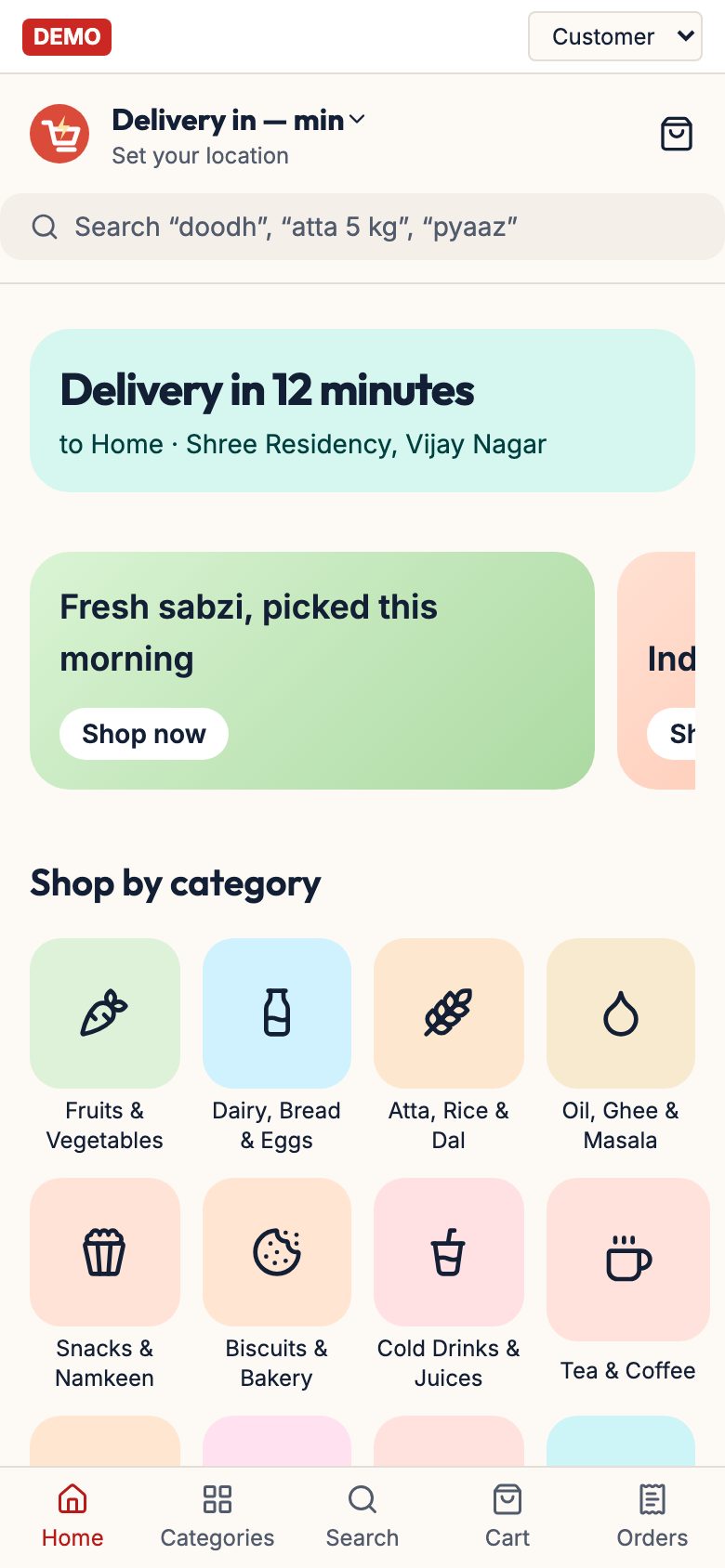
Once the store runs smoothly, delivery is the natural next step. That means an ordering app or website, a picking process inside the store and riders. Our concept build Zippora shows a shopper app with vernacular search for terms like “doodh” or “pyaaz 2 kg”, a picker terminal that sorts items by aisle from ambient to chilled to frozen, and rider dispatch with delivery proof. Our grocery delivery app page covers every side.
If you are weighing whether to build an app or start with a website, read website, app or both?.
See the app a supermarket runs on
We designed and built this concept end to end, every side of it, so you can open it and try it before you plan your own. Our grocery delivery app page covers the features, timeline and what moves the cost.
Questions people ask
How much investment is needed to open a supermarket in India?
A small neighbourhood supermarket of around 1,500 sq ft typically needs roughly ₹25–55 lakh, and a 4,000 sq ft store can need ₹75 lakh to over ₹1.5 crore. Rent, interiors and opening stock are the biggest items. These are rough estimates; get written quotes before committing.
What licences are needed to open a supermarket?
Commonly Shop & Establishment registration, a trade licence, FSSAI licence or registration, GST registration, legal metrology verification for scales, and often a fire safety clearance depending on size. Labour registrations apply as staff grows. Rules vary by state and city, so confirm with a CA or licensing consultant.
Is a franchise better than an independent supermarket?
A franchise gives you a brand, supply chain and systems, which helps first-time retailers, but you pay fees and follow their rules on range and pricing. An independent store gives you control and a local identity but needs more retail knowledge. Compare total costs and support carefully before signing.
How do supermarkets reduce losses from expiry and theft?
Through routines: weekly counts of high-value items, near-expiry checks with markdowns, CCTV, clear receiving checks against invoices, and staff accountability at billing. Good billing and stock software shows where numbers don’t match so you can act quickly, before small leaks become a monthly habit.
Should my supermarket offer online ordering?
Once your store runs well, yes. Local delivery from your own store keeps customers who might otherwise switch to apps. Start with WhatsApp orders and a picking routine, then move to your own app or website when daily orders justify it.


