The short answer
Decide what you will be known for, whether that's Bengali sweets, ghee-based mithai, sugar-free ranges or dry-fruit boxes, and take a shop on a busy market road or near temples and dense residential blocks. Set up a clean production area, register with FSSAI, and plan stock around festivals, because Diwali, Raksha Bandhan and wedding season bring a large part of a sweet shop's yearly sales.
As a ballpark, a small counter shop with its own halwai in a tier-2 city can open for roughly ₹10–20 lakh. A larger metro shop with seating, a snacks counter and a separate production unit often needs ₹40–90 lakh. This guide sets out the models, the licences and FSSAI rules specific to sweets, the money, the launch plan and how to sell boxes beyond your street.
Is a sweet shop right for you?
Mithai marks almost every Indian occasion: festivals, pujas, weddings, exam results, a new job or a new vehicle. People buy small amounts for themselves through the week and large amounts when there is news to share, and companies order gift boxes at Diwali. Families often stay with one shop for years as long as quality holds.
The business rewards people who care about consistency. Milk-based sweets spoil quickly, so you need a close eye on freshness, batch sizes and storage. It also needs someone who can handle festival weeks, when the counter is crowded from opening to closing and corporate orders pile up at the same time.
The hard parts are short shelf life, worries about adulteration that make buyers wary of new shops, skilled halwais who are in demand everywhere, and margins squeezed by the price of milk, khoya, ghee and dry fruits. A shop that is open about its ingredients and freshness earns trust faster.
Business models to choose from
| Model | How it works | Suits |
|---|---|---|
| Counter sweet shop | Fresh mithai and namkeen sold by weight from a display counter | Market roads and residential areas with steady footfall |
| Sweets plus snacks | Mithai alongside samosas, chaat or breakfast items | Busier locations; snacks bring daily traffic between festivals |
| Regional speciality | One tradition, such as Bengali, Mysore or Rajasthani sweets | Cities with migrant communities or a clear gap |
| Gift boxes and packaged range | Dry-fruit sweets and longer-life boxes for gifting | Festival-heavy sales; can ship across cities |
| Healthier ranges | Jaggery, sugar-free or millet-based sweets | Urban buyers who limit sugar; premium pricing |
A counter shop with a snacks section usually gives the steadiest cash flow. Gift boxes and longer-life sweets open the door to companies and to selling online, which is where an ecommerce website starts to pay for itself. If you plan to bake cakes as well, see how to start a home bakery for that side of the counter.
Licences and registrations
| Registration | Why you need it | Where you get it |
|---|---|---|
| FSSAI licence or registration | Required for making and selling sweets; the tier depends on turnover and production | FSSAI online portal |
| Date display on loose sweets | FSSAI requires a card beside each tray of unpackaged sweets showing the date until which they are fit to eat; the manufacturing date is optional | FSSAI orders on non-packaged sweets |
| GST registration | Needed above the turnover limit; corporate gifting buyers will ask for GST invoices | GST portal |
| Shop & Establishment registration | Registers the shop as a workplace under your state's law | State labour department or municipal body |
| Trade or health licence | City permission to make and sell food at the premises | Municipal corporation |
| Legal Metrology compliance | Pre-packed boxes need net weight, retail price, maker's details and other declarations, and weighing scales must be verified and stamped | State Legal Metrology department |
| Fire NOC | Often needed where you run large burners or bhattis, depending on building and size | State or city fire department |
If you sell boxes online or to other cities, the labels must meet FSSAI labelling rules as well as Legal Metrology. A CA or food consultant can review your box artwork before you print in bulk.
FSSAI and Legal Metrology rules are updated periodically, and enforcement differs from state to state. Confirm current requirements for your shop and your packaging with a qualified adviser. This is not legal advice.
What it costs to start
| Item | Small start | Larger setup |
|---|---|---|
| Shop rent deposit and advance | ₹1–3 lakh | ₹5–15 lakh |
| Display counters, chillers and interiors | ₹3–6 lakh | ₹12–30 lakh |
| Kitchen: bhatti, kadhais, khoya machine, exhaust | ₹2–4 lakh | ₹8–15 lakh |
| Licences, stamped scales and consultant fees | ₹30,000–80,000 | ₹1–3 lakh |
| Raw material and packaging stock | ₹1–2 lakh | ₹4–8 lakh |
| Halwai and counter salaries, two months | ₹1.5–3 lakh | ₹6–12 lakh |
| Billing, website and launch marketing | ₹40,000–1.5 lakh | ₹3–8 lakh |
| Rough total | ₹10–20 lakh | ₹40–90 lakh |
Festival weeks decide the year, so plan cash around them. You will buy milk products, dry fruits and boxes in bulk weeks before Diwali, while some corporate clients pay after the festival is over. Keep a separate festival fund, book packaging early, and note which sweets sell out and which go stale.
These numbers are for testing a plan and are not quotes; rent, finish and the size of your kitchen move them the most.
Step by step: from idea to first customer
- Choose your speciality and price band, and list the eight to twelve sweets and snacks you will open with.
- Hire or partner with a halwai whose sweets you have tasted over several batches, not just one sample.
- Find a shop with road visibility and space for a kitchen, or a production unit close by.
- Register the business, open a current account and apply for FSSAI, GST and the trade licence.
- Fit out the kitchen with proper exhaust, washable surfaces and separate cold storage for milk products.
- Get scales stamped and design boxes whose labels meet FSSAI and Legal Metrology rules.
- Prepare tray date cards so every loose sweet shows how long it stays fit to eat.
- Set up billing by weight, GST invoices and a UPI QR at the counter.
- Create your Google Business Profile with photos of the counter, opening hours and a number for festival orders.
- Open ahead of a festival if you can, with tasting pieces at the counter for the first few weeks.
- Collect corporate contacts during the first season so you can pitch gift boxes the following year.
Running it day to day
Production starts early. Halwais boil and reduce milk, fry and soak, and set trays before the shutters go up, and the counter is restocked through the day. Evenings bring the biggest rush in most neighbourhoods. At closing, unsold milk sweets are checked against their tray dates, stock goes into chillers, and tomorrow's batches are planned from what sold today.
- Freshness: make smaller batches more often; a shop known for stale stock struggles to win buyers back.
- Raw material quality: buy milk, khoya and ghee from tested sources, and spot-check for adulteration.
- Festival planning: take orders two to three weeks ahead and schedule production by date.
- Visible hygiene: gloves, caps, covered trays and regular pest control are things customers notice.
- Wastage log: record what you throw away each day by item, and drop the slow sellers.
Getting your first customers
Sweet buyers are loyal but cautious, so give them reasons to try you. Free tasting pieces, ingredient lists you are happy to share and clean presentation do more than discounts. Make sure the shop appears on maps with correct hours and photos, using our local SEO guide.
- Festival pre-orders: take orders by WhatsApp and phone a few weeks before each major festival, with pickup slots.
- Corporate gifting: send HR and admin teams a sample box and a price list for bulk orders.
- Weddings and functions: caterers and wedding planners need dependable mithai suppliers.
- Temples and community events: offer prasad boxes or sponsor sweets for a local celebration.
- Regular buyers: keep a list of customers who opt in and message them before each festival.
The tech you need
On day one you need billing software that handles weight-based items and GST, a UPI QR and stamped digital scales. Add a Google Business Profile and a WhatsApp catalogue so people can see boxes and prices. Once festival orders and corporate gifting grow, a website that takes pre-orders with a pickup date and ships longer-life boxes becomes worth it; see what an online store for sweets needs.
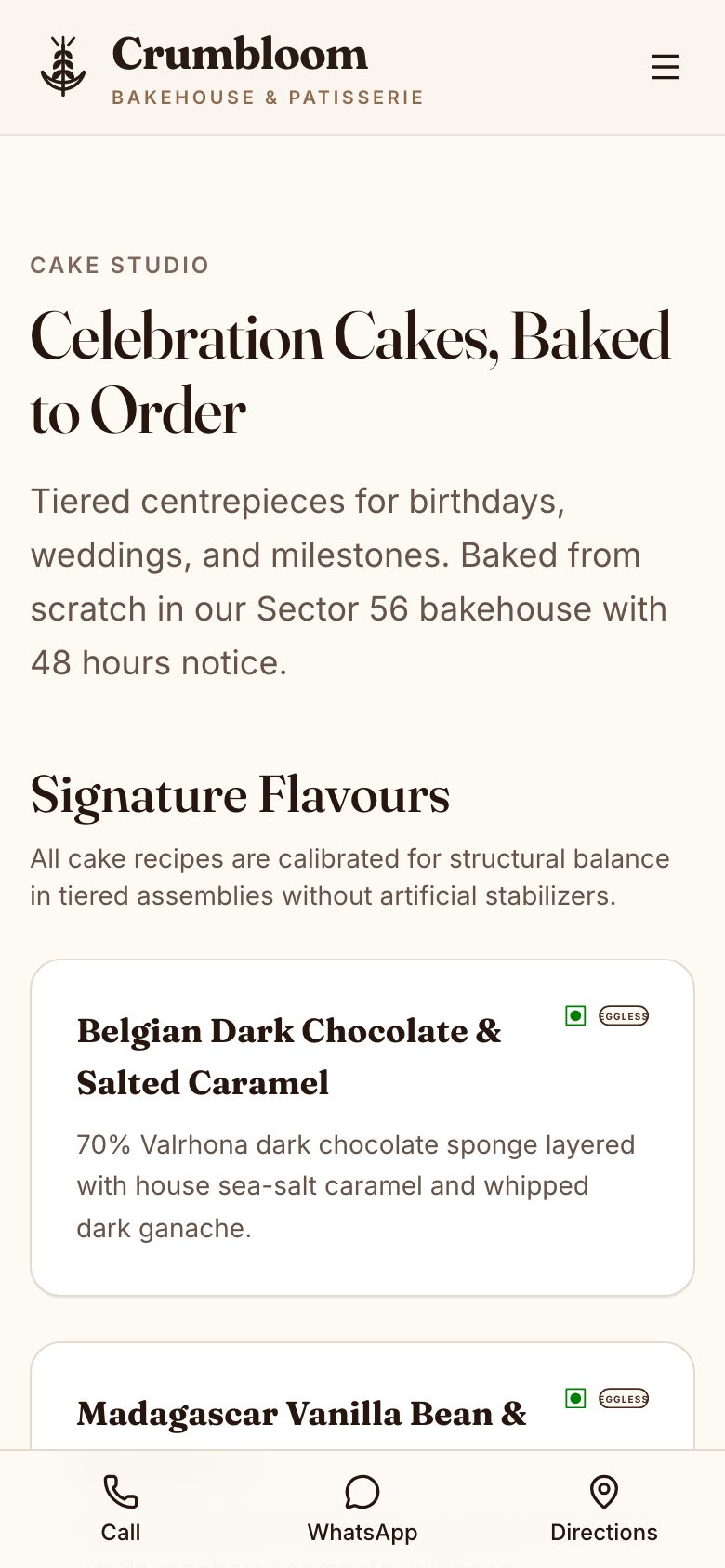
Our concept build Crumbloom, a bakery and cake studio, has the pieces a sweet shop would borrow: a box builder where customers fill an assorted box piece by piece, a live production schedule that shows what is fresh today, and pre-orders with pickup slots. For gifting, the same box builder could take a company's logo and a delivery list. Our ecommerce website guide covers shipping and payments. Send us a brief for a fixed quote within 48 hours.
See the app a sweet shop runs on
We designed and built this concept end to end, every side of it, so you can open it and try it before you plan your own. Our ecommerce website page covers the features, timeline and what moves the cost.
Questions people ask
How much does it cost to open a sweet shop in India?
Roughly ₹10–20 lakh for a small counter shop with an attached kitchen in a tier-2 city, covering rent deposit, counters, kitchen equipment, licences, stock and early salaries. A larger metro shop with seating and a separate production unit often needs ₹40–90 lakh. Display chillers and the kitchen are the main costs.
What is the FSSAI rule on dates for loose sweets?
FSSAI requires sweet shops to display, beside each tray of unpackaged sweets, the date until which those sweets are fit to eat. Showing the manufacturing date is optional. Shops set the period using FSSAI's indicative guidance and their own experience, so milk sweets usually carry shorter periods than dry or ghee-based ones.
Do I need a halwai or can I learn myself?
Most new sweet shops need at least one experienced halwai, because consistent mithai depends on technique that takes years to learn. Owners should still learn the basics so they can judge quality and step in when needed. Taste several batches before hiring, and train a second person so one resignation does not stop production.
Can I sell sweets online?
Yes, especially dry-fruit sweets, laddoos and other items that keep longer. Milk-based sweets suit same-day local delivery better than courier. Online sales need FSSAI-compliant labels, Legal Metrology declarations and sturdy packaging. Start with festival pre-orders and corporate boxes, then add a full online store once demand is clear.
Which festivals matter most for a sweet shop?
Diwali is usually the biggest, followed by Raksha Bandhan, with regional festivals such as Durga Puja, Pongal, Onam, Ganesh Chaturthi or Eid mattering more in some cities. Wedding season adds bulk orders. Plan production, packaging and staff for these weeks well ahead, and take pre-orders to spread the rush.


