The short answer
Secure a reliable milk source, keep it cold from collection to doorstep, and deliver to a dense set of households every morning before 7 am. Run it as a subscription: customers pay in advance or monthly, and can pause, skip or add items by a nightly cutoff.
Milk delivery is a daily, low-margin, high-trust business. Customers stay for years if the milk is consistent and the delivery is never late. This playbook covers models, licences, costs, launch steps and the subscription tools that make it manageable.
Is a milk delivery business right for you?
Most Indian households buy milk every day, and many still prefer it delivered to the door. Families increasingly ask where their milk comes from and whether it is adulterated, which creates room for small, trusted brands with farm-fresh or carefully sourced milk.
People who do well are disciplined about mornings and quality. Your day starts in the early hours, every day including festivals and monsoon. You need relationships with farmers or a dairy, a cold chain, and riders who turn up on time.
The hard parts: milk is perishable, so a broken chiller or late vehicle ruins a day’s stock. Quality must be identical every day. Collections across hundreds of small monthly bills can drift. And route density decides profit — scattered customers are expensive to serve.
Business models to choose from
| Model | How it works | Suits |
|---|---|---|
| Reseller of a dairy brand | Buy packaged milk from a dairy and deliver to homes on subscription | Low-capital start with no processing |
| Farm-fresh own brand | Source from your farm or partner farmers, chill, pack and deliver under your brand | Founders close to farms who can control quality |
| Glass bottle premium | Milk in returnable glass bottles, often A2 or single-farm | Affluent areas willing to pay for freshness |
| Dairy-plus subscription | Milk with curd, paneer, ghee, bread and eggs on the same morning run | Raising order value per household |
If you want to produce milk yourself, read our playbook on starting a dairy farm alongside this one.
Licences and registrations
| Registration | Why you need it | Where you get it |
|---|---|---|
| FSSAI registration or licence | You handle, pack and sell milk and dairy; the level depends on volume and whether you process | FSSAI’s FoSCoS portal |
| GST registration | Fresh milk is treated differently from processed dairy; you may need it for products like ghee, paneer or packaged items | GST portal, through a CA |
| Shop & Establishment registration | Covers your chilling or packing premises and staff | State labour department |
| Trade licence | Permission to run the business from your premises | Municipal body |
| Legal metrology | Measuring cans and pouches must give accurate quantity; packaged goods need declared contents | State legal metrology department |
| Udyam registration | MSME benefits and some loan schemes | Udyam portal |
Milk testing matters too. Even if not strictly required at your size, regular tests for fat, SNF and adulteration protect your brand and give you something concrete to show customers.
Which GST rate applies to which dairy product, and what FSSAI level you need, depends on your products and scale and changes over time. Confirm with a CA or FSSAI consultant. This is general guidance, not legal advice.
What it costs to start
| Item | Small start (100–300 households) | Larger setup (1,000+ households, own brand) |
|---|---|---|
| Chiller or bulk milk cooler | ₹50,000 – ₹1.5 lakh | ₹3 lakh – ₹8 lakh |
| Packing (pouch machine or bottles) | ₹0 (buy packed) – ₹50,000 | ₹3 lakh – ₹12 lakh |
| Delivery vehicles | ₹70,000 – ₹2 lakh (1–2 two-wheelers) | ₹6 lakh – ₹15 lakh (EVs or small vans) |
| Crates, insulated boxes, cans | ₹15,000 – ₹50,000 | ₹1 lakh – ₹3 lakh |
| Premises deposit and setup | ₹20,000 – ₹1 lakh | ₹3 lakh – ₹10 lakh |
| Testing equipment | ₹10,000 – ₹40,000 | ₹1 lakh – ₹4 lakh |
| Working capital (milk is paid for daily) | ₹1 lakh – ₹2 lakh | ₹8 lakh – ₹20 lakh |
These are planning estimates, not quotes. Farmers and dairies usually expect payment quickly, while customers pay monthly, so working capital is often the number founders underestimate.
Step by step: from idea to first customer
- Choose your source. A dairy brand to resell, or a few farmers you can visit and test regularly.
- Test the milk. Check fat, SNF and adulteration for a few weeks before you sell a single litre.
- Set up cold chain. Chilling at collection, insulated transport and a short time to the door.
- Register. FSSAI first, then GST and local registrations as needed.
- Pick a dense first area. Two or three housing societies close together, so one rider can do a full route before 7 am.
- Design the subscription. Daily quantity, a nightly cutoff for changes, pause and skip rules, and how billing works.
- Decide payment terms. Prepaid wallet, monthly bill, or UPI AutoPay; prepaid protects your cash flow.
- Hire and route riders. Fixed routes sorted by building and floor, with a list of empty bottles to collect.
- Run a free trial week. Let families taste the milk; most decide in a few days.
- Collect feedback and fix. Late deliveries and leaking packs must stop before you add the next society.
Running it day to day
The cycle is unforgiving. Orders close the night before, you total tomorrow’s litres and place your procurement, milk is collected and chilled in the early hours, and riders leave on fixed routes so every bag is at the door before people wake up.
The nightly cutoff is your control point. After it, quantities lock and procurement goes out. Make the cutoff clear to customers and stick to it, or you will always have too much or too little milk.
Route density decides margin. Sort stops by tower and flat, and say no to isolated addresses until a cluster forms around them.
Bottles and crates come back. If you use glass, track empties per household. A small deposit on bottles keeps returns honest.
Collections need a system. Hundreds of small balances get messy fast. A prepaid wallet or automatic monthly debit, with a clear statement of every day’s delivery, prevents arguments.
Getting your first customers
- Trial packs in societies. With the RWA’s permission, offer two free days to interested families.
- Show your source. Photos or short videos of the farm, test results and how the milk is chilled build trust quickly.
- Google Business Profile. People search “milk delivery near me”; set up your service area properly. See our local SEO guide.
- WhatsApp. A group or broadcast for each society to announce new products and holiday schedules.
- Referrals. A free litre for both families when a neighbour subscribes.
The tech you need
At a few dozen households, a spreadsheet and WhatsApp work. Beyond that, changes, pauses and monthly bills get out of hand quickly. That is when a subscription app pays for itself.
- Customer app or web page with a calendar to pause, skip or add items before the cutoff, plus a wallet and statement.
- Delivery app with the route in order, items per stop, empties to collect and proof of delivery.
- Owner dashboard with tomorrow’s total litres, procurement, route sheets and low balances.
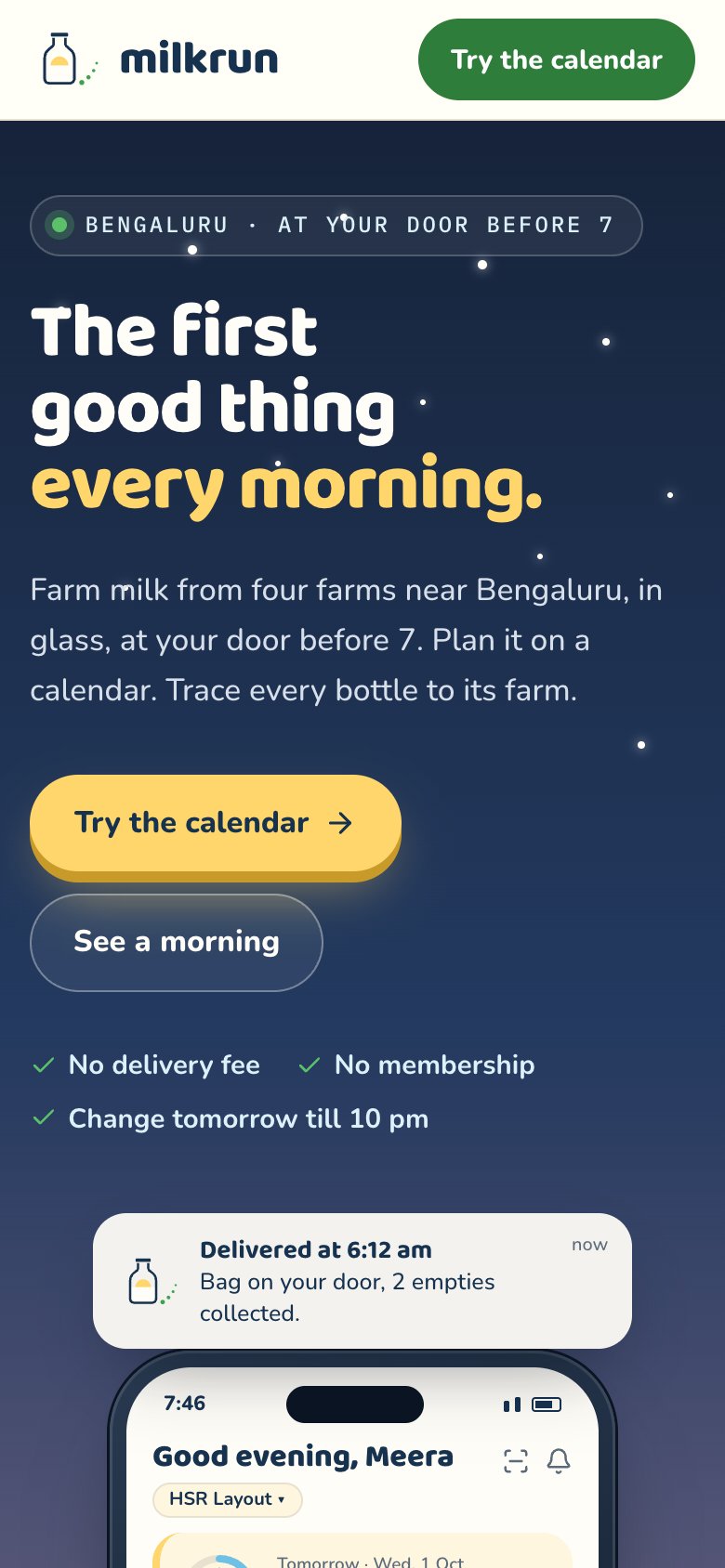
Our concept build Milkrun shows a calendar-first subscription with a 10 pm cutoff countdown, a bottle wallet, a pre-dawn route manifest with empty-bottle pickups, and nightly demand aggregation for procurement. Our subscription delivery app page explains every side. For recurring payments, read about UPI AutoPay mandates in adding UPI payments to your app.
See the app a milk delivery business runs on
We designed and built this concept end to end, every side of it, so you can open it and try it before you plan your own. Our milk & subscription delivery app page covers the features, timeline and what moves the cost.
Questions people ask
How much does it cost to start a milk delivery business?
Reselling packaged milk to 100–300 households can start at roughly ₹3–8 lakh, mostly chilling, vehicles and working capital. An own-brand operation with packing, testing and 1,000+ households can need ₹25 lakh or more. These are planning estimates; procurement terms change how much cash you need.
Do I need an FSSAI licence for milk delivery?
Yes, you generally need FSSAI registration or a licence to handle and sell milk, and the level depends on how much you handle and whether you process or pack it. Check the exact category with an FSSAI consultant or CA before you begin selling.
How do milk delivery businesses handle monthly payments?
Most use prepaid wallets, monthly bills or automatic recurring payments. Prepaid wallets protect cash flow because you pay suppliers daily. Whatever you choose, give customers a clear daily statement so pauses, extras and deductions are never a surprise, and settle disputes the same week.
How early does milk need to be delivered?
Most households expect milk before 7 am, and many earlier. That means collection and chilling in the early hours and fixed routes leaving well before dawn. A clear, consistent time matters more than the earliest possible time, because families plan their mornings around it.
Should I use glass bottles or pouches?
Glass bottles feel premium and reduce plastic, but need washing, sterilising and return tracking, which adds cost. Pouches are cheaper and simpler to handle. Many premium brands use glass in affluent areas and pouches elsewhere. Start with what you can run reliably every single morning.


