The short answer
A taxi app is three products that have to agree on one live map: the rider app that books, the driver or captain app that accepts, and the ops dashboard that keeps a city running. A first version for one city and one vehicle type usually takes ten to twelve weeks to design and build properly.
The booking screen is the easy part. Matching, driver onboarding, safety and payouts are where the work — and the trust — really sit. This guide walks through each, using our Hoppr bike-taxi, Wayvero carpool and Peakride rental concepts as examples.
The three apps in every ride
| App | Who uses it | What it must do well |
|---|---|---|
| Rider app | Your customers | Book in two taps, show the fare up front, track the driver, pay, share the trip, raise SOS |
| Captain or driver app | Your supply | Go on duty, accept or decline, navigate, collect payment, see earnings and payouts |
| Ops dashboard | Your team | Watch demand and supply live, onboard and verify drivers, handle complaints, refunds and SOS |
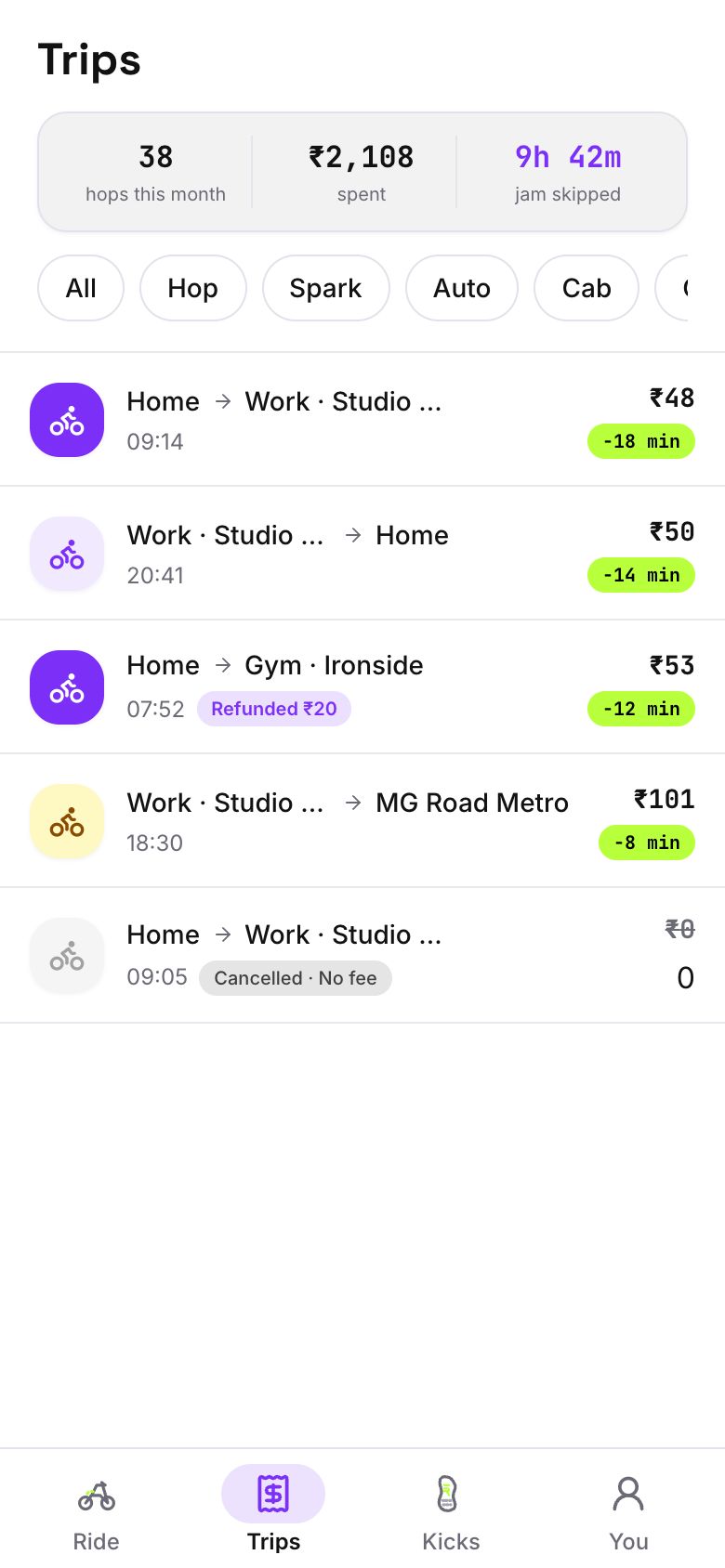
Hoppr has all three: a rider app with live matching, a captain app with ten-step onboarding and earnings streaks, and a Pulse Board that shows demand as a heatmap with surge caps and a live SOS feed. If a quote covers only the rider app, ask what happens on the other two.
Matching and the live map
When a rider books, the system has to find a nearby driver who is free, likely to accept and able to reach the pickup quickly. A simple version offers the ride to the closest drivers one by one. A better one widens the search radius over time and learns which drivers accept which trips.
- Location updates from driver phones every few seconds, without draining the battery or the driver's data pack.
- ETAs that account for traffic, not just distance.
- Pickup points that use landmarks and gates, because a pin in the middle of a society is not a pickup point.
- A visible search state. Hoppr's Match Pulse shows riders that the system is working, which cuts cancellations while they wait.
Maps, routing and location services are usually billed by usage. Estimate monthly map calls for your expected trips before you choose a provider; it is a running cost, not a one-time one.
Driver onboarding and safety
Riders trust the brand only as much as they trust the person who turns up. Onboarding is a safety feature, not paperwork.
- Document capture for licence, vehicle registration and insurance, with an ops queue to verify them.
- A selfie check at the start of a shift, so the person driving matches the person verified.
- For bike taxis, a helmet check for the captain and a spare for the rider. Hoppr's captain app includes one.
- Trip sharing with family, a one-tap SOS that reaches your ops team, and a record of the route.
- Options riders ask for, such as a women-only toggle. Wayvero shows trust badges on every driver and lets riders filter for women-only rides.
Fares, payments and payouts
Fares are usually a base fare plus distance and time, with rules for waiting, night hours and cancellations. Show the fare before booking, and explain any surge in plain words. Caps on surge build more trust than they cost.
- Payments: UPI, cash and sometimes a wallet. Cash means the driver owes you commission, so the app has to track that balance.
- Driver earnings: commission per trip, or a daily or weekly subscription. Hoppr's captain app offers a Day Pass so captains keep the full fare.
- Payouts: daily or instant payouts matter to drivers far more than a slightly higher rate. Build the settlement report for your team at the same time.
Our UPI guide covers collecting payments, refunds and reconciliation in more detail.
Not every mobility app is a taxi app
The same building blocks power very different businesses. Pick the model before you pick the features.
| Model | Example build | What's different |
|---|---|---|
| City ride-hailing or bike taxi | Hoppr | Instant matching, surge, a large driver pool, SOS |
| Intercity or commute carpool | Wayvero | Drivers post a trip with stops; riders book seats along the route; fare split per seat |
| Vehicle rental | Peakride | Bookings by the day, deposits, an offline handover checklist with damage photos |
| Goods transport | HornOK | Vehicle size, loading help, proof of delivery; see our logistics app page |
Rules and permits
Passenger transport is regulated by states, and the rules for app-based aggregators, bike taxis and commercial number plates differ from one state to another and change over time. Some states have allowed bike taxis; others have restricted them.
This is not legal advice. Before launch, check your state's current rules for aggregators and the vehicle types you plan to use, and design the app so features such as city availability can be switched off per city without a new release.
Mistakes that sink ride apps early
- Launching in a whole city at once, so riders wait too long everywhere instead of being matched quickly in one area.
- Spending on rider promotions before there are enough drivers online at peak hours.
- Paying drivers weekly when competitors pay daily, then wondering why they stop logging in.
- Leaving the ops dashboard for later, so the team handles complaints and SOS alerts from phones and spreadsheets.
A realistic plan for a first version
- Weeks 1–2: pick one city, one vehicle type and one payment model. Map the rider, captain and ops journeys.
- Weeks 2–3: brand and design system, so all three apps look like one company.
- Weeks 3–10: build the three apps together, with simulated rides running from week one so the team can test the whole loop.
- Weeks 10–12: a pilot with a small group of real drivers, then launch in one area of the city.
Many founders launch with some of the ops work done by hand and automate it once they see the real patterns. That is a sensible way to keep the first version focused; see our MVP guide. For scope and a fixed quote, look at our taxi booking app page or send a brief.
Questions people ask
How long does it take to build a taxi app?
About ten to twelve weeks for a first version covering one city and one vehicle type, with the rider app, the driver app and an ops dashboard built together. Adding more vehicle types, cities, corporate accounts or a wallet extends the timeline. A two-week concept sprint can produce a clickable prototype first if you need to raise or test the idea.
Do I need a separate app for drivers?
Yes. Drivers need a different product: going on duty, accepting trips, navigation, collecting cash and seeing earnings. Combining both into one app confuses everyone and makes store review harder. The two apps share one backend and one design system, so the cost is lower than building two unrelated apps.
Will the driver app work on cheap Android phones?
It should, and we design for it. Most drivers use mid-range Android phones on prepaid data, often while running navigation at the same time. That means light screens, careful location updates to save battery and data, large buttons that work with gloves or in sunlight, and flows that survive a dropped signal mid-trip.
Are bike taxis allowed in every state?
No. Rules for bike taxis and app-based aggregators are set by states and differ across India, and they have changed over time. Check the current position in each state before launch, and build the app so a city or vehicle type can be switched off without a new release. Take legal advice for your specific plan.
How do taxi apps make money?
Usually through a commission on each fare, or a daily or weekly subscription that drivers pay to keep the full fare. Some add convenience fees, corporate accounts or advertising. The model affects the app: subscriptions need passes and renewal reminders, commissions need settlement reports and cash balance tracking.


